Summer break

The blankets pulled snugly around me on that August morning, in a laughing dare for me to get out of bed.

An August mornings too often are of miserable heat and humidity, that of the sort which make rising from bed as good of an alternative as any in the old Eimon Homestead farmhouse. It’s when summer happens, with so much to do before the day’s heat pulls itself around every breath a being tries to draw.

A hint of autumn seemed to be in that morning’s air; the sounds of a gentle summer rain pattering on the old house’s roof and on the leaves of the willow, oaks and walnuts added comfort to my spirit.

Even the birds around the farmyard’s trees and at our feeding stations seemed to tell me what I was feeling as I pulled the blankets ever-so-closer around my body, a couple families of about 20 young grosbeaks talking about it at the feeders in soft-toned “mweep, mweep, mweep.” The birds that morning were low-key in their voices in the same ways I was feeling low-key.

The conscience of the old farm inside my spirit reminded me that this wasn’t the sort of day that the corn on so many of our ridges would need. This time of the year, the corn begs for a few extra sweltering days of sun and humidity – those summer dog-days when little more than the corn and a few heat-miser humans like. It was the antonyms of the sorts of summer days when Dad would have said, “Yep, you can hear the corn growing today” in response to my whines that the day was too hot.

My conscience also reminded me that most parts of our county wouldn’t need the extra rain that was falling, parts downstream from our ridge already having been oft-flooded by this season’s overflowed banks of ditches, creeks and rivers.

One of our dairy-farming neighbors across the ridge confirmed later that day how I was right about my worries that the crops other than our farmyards’ lawns were gaining much on a day such as this; another soul south toward Old Man River confirmed that we didn’t need more rain.

As I started to gather my morning wits I started wondering what, then, might be joyous in my feelings about such a cool and otherwise rainy and drab summer morning? It was too early in August to even declare that the morning was an arrived-too-early precursor to autumn’s cool splendor.

It eventually occurred to me that my very physical response to what I’d woken to was the answer: This day is one in which nature has called a short time-out to allow us to recover enough to help us be ready for the month’s single final push of summer.

Sometime near the end of each May, we and everything around us downshifts and revs our collective engines’ RPMs to make a big push into the late spring and through summer. All goes high-velocity and high-paced to make things happen – playing, growing crops, gardening, doing home repairs, community festivals, livestock shows, the county fair, fixing highways…. We start in a rush and keep the pace fast until we start to feel autumn’s cool days.

We even seem to relax in a hurry.

Long spans of daylight allow us to pick up the pace even more, especially when we start to see the daylight faltering ever-so-slowly and we start to hear the distant sounds of school bells.

We nearly panic as we hear the click-clack of high school football players’ cleats hitting sidewalks as the players head toward their schools’ practice fields. If football season is nigh, how soon can it be before we see leaves changing colors and falling from trees and then feel the onset of winter’s freeze? It’s click-clack time, then, to get all that’s summer packed into what remains of summer.

Our beloved northern Driftless Area is a place where most of us take pride and happiness in living life at a pace that’s a bit slower than in many other parts of this big old world, but even here we can find ourselves in a constant road-race everywhere between Osseo and Trempealeau.

And then that cool and rainy morning arrived in early August, it holding the summer coolness and moisture that we didn’t necessarily need. Its arrival slowed us down for a while, the morning reining some of us to a complete stop.

Life went on as usual, and there certainly were those whose pace couldn’t be slowed by that morning’s coolness and steady summer rain. But as I finally pulled the blankets from my chin and rose, I think I heard a collective sigh echoing across the northern Driftless Area’s ridges and valleys.

The land, its people, its crops and even the air got an ever-so-brief moment to rest from summer’s fast pace — a pace I noted as I pulled the blankets higher and drifted back into a morning slumber.

— Scott Schultz


Covenants with the land

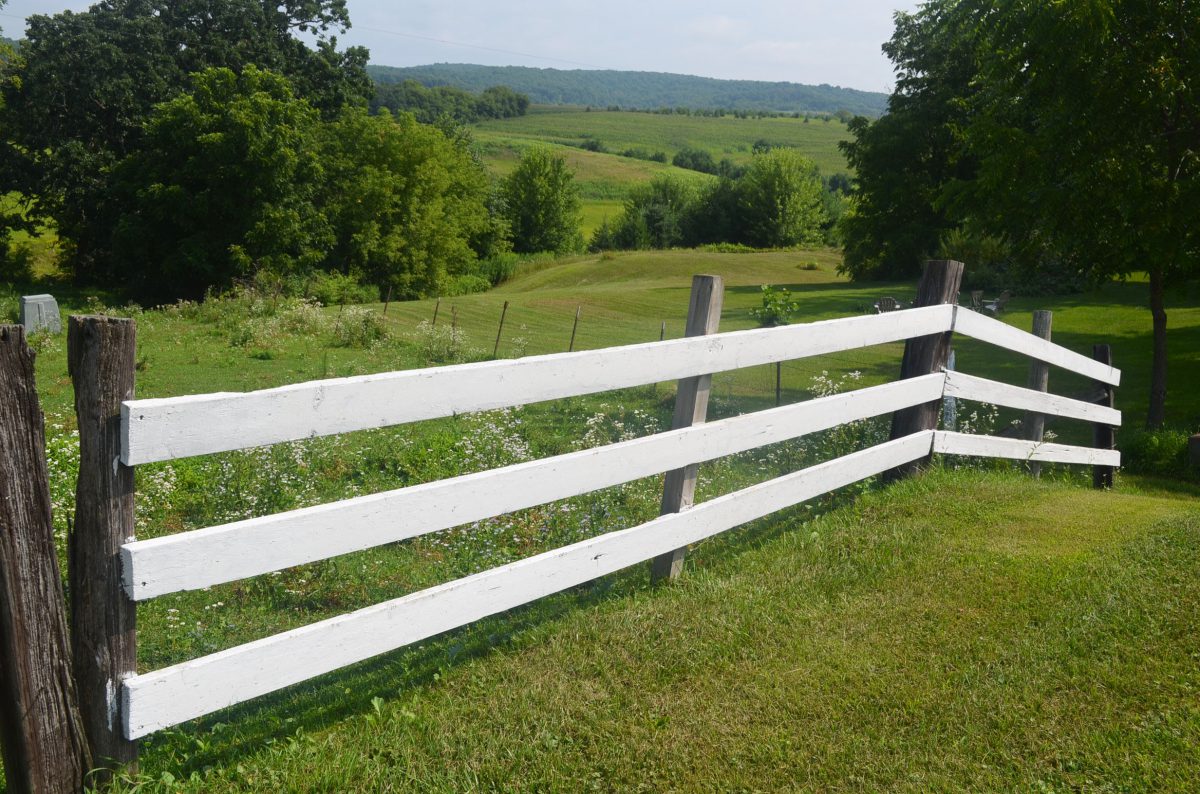
There are times when it’s important to consider the covenants we have with the soil and all that’s on it. Such a time came the other day as I stepped into a forested piece of the rural countryside.

The air was a little heavy with July’s humidity, the summer heading into its dog-days when rural kids are told to stay away from their local swimming holes but splash in the warmed water anyway, despite their parents’ warnings.

The air immediately closed tightly around me as I entered into the woods, seeming to make my breathing even more difficult.

My head lightened a bit, making me worry that the forest’s air had become so thick with summer’s lushness that it was closing around tightly and suffocating me.

But then, a new awareness emerged from the leaves – an awareness I remember feeling on so many other visits to that forest: The light-headedness I felt was the result of intoxication from the wonderfully cleansed oxygen the trees produced.

The forest’s air drips with that oxygen, and I remembered how the forest is a place for renewing my oxygen reserves, and not a place of suffocation.

The forest is a place that inhales all the deadly carbon monoxide waste my breath offers, filters it and exhales its purified oxygen to sustain life for me and so many other beings.

It would be easy to know we have such a life-giving agreement with the forest, but lucky are those among us know that the covenant’s fine print offers more.

Some of us know that, like our breath’s wastes, the forest can take into its floor’s duff-carpet the daily worries of a person’s spirit. And just as the forest filters our breathing waste into life-giving oxygen, it filters our worries and renews the heart with a cleansed spirit.

That covenant also has language in which the forest filters the day’s noise and turns it into gentle leaf-rustles, calming us with the gentle sounds of big-water waves moving against the horizon.

I again considered that agreement early on a late July morning.

The air again weighed heavily in that previous night’s summer heat. I’d negotiated then with the land that I’d honor it in verse if it would open itself to show me that autumn somewhere in the future.

The air still was heavy with humidity that morning, but in a way that brought the sky and the soil into one. The Timber Creek coulee below to the north was covered with a morning haze, as were the trees in the woods to the south. The ridge, somehow, was left clear.

I worried at first that the land wasn’t honoring our agreement until I carried my cup of morning coffee into the farmyard to get a better look at what the day was offering.

There, a clip of cool air slapped my bared arms.

Steam rose from the hot coffee.

Somewhere in that air lingered the autumn mornings for which I so lust during the years’ hottest days. It still would more than a month before its reality, but that morning I felt its presence.

The soil again had kept its part of the bargain.

The air was inviting enough to draw me to one of the farmyard’s Leopold benches to share my coffee with nature’s morning richness.

I gleefully accepted.

It was a few minutes before the sun rose fully in the east and started to pull the white haze from the slumbering creek and trees. They yawned a “good morning” greeting to me on a gentle breeze of cool morning air.

Words dripped from the breeze as it caressed my being, those words helping me honor my part of the agreement:

“I find an early morning moment to laze on a Leopold bench among the blossomed hostas. Mourning doves provide soothing music as I contemplate the azure beauty above and the verdant shades a gentle breeze moves across this northern Driftless Area soil.

The hum of frenzied work on honey bees’ wings among blossoms and of hummingbirds at nearby feeders threaten to belie the lazed mood. Instead, they only add to the land’s soothing music.

A young rabbit joins my party, settling a few feet from me in its mute nose-wiggling contentment of sampling the farm-yard’s grass. Together, we watch in silence the cardinals, jays, grosbeaks, orioles, buntings, grackles and finches quietly foraging at a feeding station.

In this place I find my peace with relaxed sips from a favorite coffee mug. Life just then has slowed to the best of unwound moments.”

I’m sure there are many things I haven’t read in the covenant, and my life likely will end before I know all that’s in the agreement. That, of course, will require steady returns to the forest to learn more – and, to take advantage of all the renewal I already know it offers. It will require constant negotiations so I’m allowed to take parts in moments that so allow the unwinding of whatever self-made tensions might be in me.

The only thing of which I’m sure is that this land and all around it is open to wondrous deals that bring fullness to me. It’s important that I remember to take the time and be willing to negotiate.

A well-done deal with the soil is life itself.

— Scott Schultz


Feeling summer’s weight

It’s easy this time of the year to feel as though things are closing in around us, nature itself getting a little too close to us for comfort.

Even the breath we draw in the morning has a closeness to it, the heavy mid-July air pushing heavy against our chests as we take in life-giving oxygen that’s still laden with the past day’s heat, and which soon will be steamed with the coming day’s heat. On a steamy mid-July morning, what in other seasons is a freshness in the air can make us wonder whether this is what it’s like to breathe under a pile of heated bricks.

Barns are dampened with the inescapable humidity, the floors slickened to make treacherous walking for Holsteins and humans alike; haymows become rural saunas.

These, the start of the dog days of summer, are times when even the water down at the old swimming hole – that water that a couple weeks ago was so refreshing to our beings – is uninviting. And at beaches and pools, children’s feet are singed by sand and cement that have collected the very sun that they’re trying to avoid.

Even the smallest of critters, the gnats, “no see-ems” and skeeters, close in around us and push heavily against us. Any time outside, especially with the heavy darkness of the night-air’s lead-weight blanket pulled over us, requires age-old bug repellents that we’re never sure are good for us and always sure is uncomfortable for us. But we use the repellents in hopes that we can stop the unending swatting and flailing that has been so ineffective in pushing the critters away from us.

The shelters that at other times protect us from other seasons’ elements become either ovens that we don’t want to be in, or jail cells with cool air that keeps us trapped within. Front porches were built for times such as these; porch swings and rocking chairs invented for people who hope to find the margin between being trapped inside while still escaping the weight of the mid-July air.

Iced tea. Cold Coke. Well-chilled beer. A simple, refreshing glass of water on ice. All of which pour droplets of temple-cooling wetness down the outsides of containers.

We know to not go into the woods unless we absolutely have to, an excuse being to retrieve a renegade calf or the like. There, the gnats and skeeters that push themselves onto us in the open air seem minor to the thick swarms of biting flies, and an entomologist’s dream of other bug species that weigh down upon us. The deer choose the risk of cars’ headlights instead of remaining in the close confines of July’s bug-laden woods, so why would we want to go there unless we absolutely have to be there?

Though we don’t necessarily want to be in the woods, even a walk down some rural roads brings the woods to us. The trees, bushes, shrubs and ferns reach out to press against our space while we take morning or evening walks. That which will draw color-seeking tourists in two months are mere waves of deep green, an ocean reaching out to drown us in fauna.

Where other times invite us to the earth, mid-July certainly makes the earth foreboding.

But then in the evening air we see sparkles of light that remind us that entering the depth of summer has positive values. Sometimes it takes watching the carefree and random movements of light from summer’s fireflies to remind us how summer also can make us carefree and random.

Just when we think the weight of summer’s air is unbearable, we can look to those fireflies and see the openness of a cloudless night sky – in it, so many distant stars that light escape routes to lead us away from summer’s earthly fires.

And unlike so much around us this time of year, we see the fireflies’ twittering lights moving away from us, each removing from our chests a little piece of the summer air’s burdens.

This time of the year in the countryside, if we allow summer’s weight the chance to buckle our knees, it certainly will. But with the spirit our rural fathers passed to us, we’ll continue to look toward the fireflies or any other little sign that this too will pass.

We know that a few short weeks from now will bring us new openings in the air, the soil and even the woods. It will again feel good to do physical labor, to be out in air that’s light and fresh. We’ll even get to see the daytime sky without the thick haze that July pulls across the horizons.

Like a robin’s song breaks a summer morning’s predawn silence, we will break through the heavy cover that lays upon us in mid-July. And then, like all other seasons, we’ll even bank some pleasant memories that we found when it seemed all was closing upon us.

— Scott Schultz

Photographing the land’s moments

Wild flowers and wild fires combined a while ago to present some of the most splendid photographs imaginable. Even the rawest photographic rookies were bound to capture hazy beauty cast on the region’s wild flowers blooming in smoke drifting south from large Canada wild fires.

Those nature-provided special effects especially were apparent during northern Driftless Area sunrises and sunsets, when the smoke combined with deepening summer ozone to filter the sun’s bright heavy-metal screams into soft-orange meditative symphonies. No computerized digital enhancement could improve the spectacles shown to us.

A similar moment flagged my attention the other morning as I was driving along an area highway. The sun was peeking through a hole in the clouds, allowing only sprays of silver light to streak from the darkened sky. Shadowed green fields and woods slow-danced in the breeze under the mirror-ball lights darting from above.

I glanced toward Dee, who was riding in the front passenger’s seat, to share the moment with her and ask whether she could grab the camera and photograph the scene. But a busy previous night and that day’s early start had gently taken her hand and playfully led her down slumber’s dreamy path, so I remained quiet and went back to focusing on driving.

Focusing on the highway became increasingly difficult as the clouds opened further to allow more of the sun’s lasers to hopscotch the corn’s leaves. Fields and trees otherwise monotone turned into a summer morning’s garden salad of greens.

Dee stirred, and I again hoped she was waking to share the splendor falling from the heavens. But she repositioned herself on the seat and continued to sleep; her face turned and exposed her right cheek to caresses by one of the sun’s extended fingers.

I laughed to myself about how it wouldn’t help to ask Dee to use the camera, only then remembering that we’d left the camera back at our farm. The idea of using the camera on one of our cell phones crossed my mind, but I didn’t want to do that while driving and I was staying with my conviction of allowing Dee that much-needed rest.

Instead, I took the photograph with my eyes and allowed my mind to process it deeply into my being. It would be, for the time being, a photograph that I’d hold within while it developed into words I could use to paint the picture.

There have been plenty of moments during my time when that’s happened, and there are times when I decide to not share with others the pictures that result. Mostly, though, I feel a need to share what I’ve seen – a personal thing for which I won’t criticize or deny others when it comes time for them to make such choices. Some people, I know, are content in holding their eyes’ pictures for only themselves.

The concern I have is that we do that too often, keeping too much to ourselves without preserving some of today for generations to see tomorrow.

The scenes change here in the northern Driftless Area, no matter how we want them to remain the same. I look at photographs of our old Eimon Homestead farm and see trees where 100 years ago there only was grass, and see grass where 100 years ago there were trees. Buildings at the farm have come and gone and come. I’m happy people took photographs so I could know this place so much better than I could if I hadn’t known what formed it and what leaves enriched its soil.

It’s too easy to take for granted that generations will know what our ridges and coulees held and what our hands did to reshape the ridges and valleys into what they’ll have become, good and bad. And, it’s too easy to believe all we see is only for me and not for us.

Sometimes, though, I’ll go with using only my eyes to photograph something so spectacular as the sun beaming through the hole in those clouds, allowing that moment for me.

The hole in the clouds closed a couple minutes after it had allowed me time to enjoy their games with the sun and to take the special photograph I’ll carry with me for the rest of my mortal days.

Fireworks in the windshield

We sat slightly reclined in our car’s bucket seats and listened to some old-time radio shows while we waited for Pleasantville’s fireworks display to start the other night.

The Fourth of July had taken its toll on us, so we decided to relax in the vehicle to watch the community’s population swell far beyond its capacity as the annual celebration was carried into dusk, and then to use the car’s vantage point to watch the fireworks.

Sitting in the car that way to watch fireworks usually doesn’t cross the minds of most people from birth through their child-rearing years. But, there apparently comes a time in a person’s life when it’s OK to put away the lawn chairs and blankets and sit back in the solitude of your car. That night I looked to our left and then to the right to see folks a bit older than us doing exactly as we were, occasionally getting out to grab popcorn or other goodies from the park’s concession stand and then return to their cars.

I quickly realized the car was a great place to have an overview of a community’s entire celebration, the windshield and windows providing a muted snow-globe look at the scene and its events.

Softball teams’ players moved in sporadic darts.

The crowd moved with collective inhales and exhales around the concession stand and shelter.

Parents carried their smallest children to and from their cars, cat-herding their toddlers along the way.

Young men showed off their mechanical strength by revving loud-mufflered vehicles while moving slowly between people walking on the county highway’s fog-lines.

Hormone-dazed teenagers roamed the road hand-in-hand, not knowing whether they should be walking to the north, south, east or west — knowing they eventually should be walking in some direction but, in the moment, direction not mattering.

All celebrated in their own ways, but the coming fireworks were the only things that mattered to any of them. No matter how any among those couple-thousand people might disagree, the fireworks were what that night was all about.

Fireworks on or about the Fourth of July are part of our small-town DNA, firing our rural-community synapse as surely as freshly-cut hayfields and noon fire sirens.

From our vantage point we saw flashes echoing across the sky from other area communities’ fireworks and from some of the area’s farmyard fireworks that started ahead of Pleasantville’s display. And, of course, there were the always-expected occasional whistles, sizzles and bangs produced by small-scale explosives and pyrotechnics produced on the park’s perimeters by the neighborhood BYOF (bring your own fireworks) people.

The night dampness settling in, I had to start the car a couple times to run the defroster to assure we could see out the windows. It was reminiscent of youthful moments watching star-studded blockbusters on drive-in theaters’ big screens. That night’s feature, “Pleasantville Fourth of July Fireworks,” was played on the big screen of rural life and starred Trempealeau County’s people of the soil.

The day’s last softball game ended, and the park darkened. Within moments of the softball field’s last flickering light, a stream of colors poured skyward and then burst into an oblong pattern of red, white and blue to relight the park.

The fireworks show was on.

Most of us have seen big-city fireworks in our time, a constant pour of colors and shapes filling the sky and the sounds arriving so quickly they become a constant rumble. But the Pleasantville fireworks, as a rural community’s fireworks should be, were fed to us in savory sips instead of drunken gulps.

The display was paced correctly to allow the proper reactions of oooos and aaaaaahs reflexively emitted from our inner beings. When fireworks are spaced correctly, even the hardest of souls can’t fight the involuntary eruption of youthfulness the booming colors pull from within us.

At Pleasantville, we had that rural fireworks display moment when we uttered, “What, that’s the end?” — only to be surprised by the sudden eruption of a quick-hitting orgy of colors. Within moments, as though scripted, we were returned to the pace to allow the properly-paced oooos and aaaaaahs.

And then, they were finished, us heading into those few minutes of guiding our car among other cars making their ways into the countryside’s darkness, and being vigilant for young parents bent on getting overtired children into vehicles.

Finding our space along county Highway E and then county Highway EE, we agreed that Pleasantville’s fireworks was worthy of praise as rural communities’ fireworks go. Our sporadic conversation occasionally broken by deer-sightings, we also agreed that we’d return during coming years – along with some of those displays offered by our county’s other communities.

We might even watch more while sitting in our car and listening to old-time radio shows.

Weeping for the willow

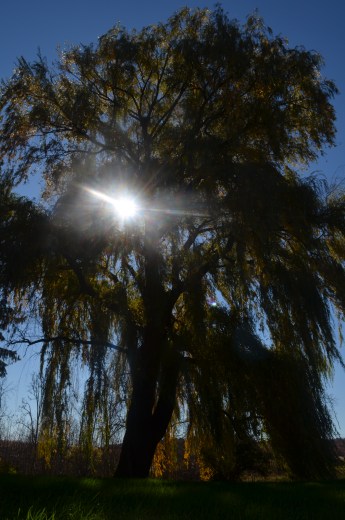
There’s a hole in our farm’s heart, a hole that’s easy to see directly from the south window in my office of this old farm house.

I’ve been looking out of the window during recent days, somehow hoping that time could be turned back and that hole in the top of our grand old willow would be re-filled with its long tangles of twigs and leaves. Instead, the tree weeps of branches wrenched from its being during a mid-June storm that pillaged and plundered its way across this northern Driftless Area’s soil.Willow tree2 102214

The storm of wind, hail and rain stretched every fiber of the old willow, the tree’s leaves still turned pale compared with the lush fullness I’ve admired on past summers’ days. Occasional leaf-tears flitter through its Rapunzel branches and spatter on the grass below.

My sadness for the way the tree looks since the storm is replaced by me counting the coins of fortune that the tree stands at all, and that our Eimon Ridge farmstead wasn’t damaged more heavily by that storm. Others across the countryside didn’t have such fortune.

Photos from that night are plenty, including people holding hail the sizes of golf balls and baseballs; the hail punched holes in houses’ siding and shredded the green from some fields, trees and gardens.

Trees were broken at their trunks and even fully uprooted.

Corn fields, some of which already had been replanted after flood-causing rains, were gullied and washed down hillsides.

A neighbor’s small shed was blown off its foundation.

That such damage was limited to here-and-there places doesn’t matter, as I count my fortune-coins – if the storm created a hardship for a handful of one of us in this countryside, they’re hardships felt by all of us on this land. It seems we all realize our turns at knowing such hardship.

Our sickened willow also fared better than that of a willow owned by a writer-friend on the other side of the state. Later that night, the same storm had totally blown over his farm’s grand willow.

Though the perspective of our good fortune helps me cope, it still gives me pain to see the suffering of that tree.

Erling, whose family arrived from Norway and homesteaded this ground during the mid-1800s, tells me he planted the tree in his earlier years, using a cutting from previous generations of the farm’s willows. It’s risen to stand guard over several generations whose souls haunt this old house.

The willow is home to critters beyond my count, the orioles and grosbeaks hanging sideways from those Rapunzel branches and hiding nests in its safety. Squirrels use the tree to nest and enjoy walnut treats from other nearby trees. The list of animals using it as a home seems endless.

Its striking majesty and girth have given it a sort of public celebrity over the years. Passersby traveling by automobile, on horseback, on bicycles or afoot occasionally stop on the road to gaze at the old willow.

The tree also has long been a point of goodhearted contention among those who’ve lived on this farm. Among that group, every three words of praise are met with a word of complaint about how the Rapunzel limbs tangle people and equipment caring for the farmyard under the tree.

Though we’ve already spent a few years of borrowing this place from its soil, it wasn’t until this spring that I realized the tree’s importance on our farm. On that evening, Dee and I rode our utility vehicle to the top of the ride on the next section over. We stopped for a while to take in what spring offers, noting how the trees were gaining their season’s green.

And then, looking down to our farm’s buildings, we seemed to notice simultaneously how the old willow dwarfed our house and everything else on the farm. The willow tree is the farm’s queen, a title bestowed not by mere humans but by nature itself.

I’ve considered the reality that my concern for the old willow is as more about my mortality than it is for the tree’s mortality. We all understand how long it takes such old trees to grow, after all. We imagine all of what it might have seen.

So, my mortal being asks, if trees such as grand old willow and other aged trees – those figures to which we’ve seen represent such strength – break and fall, how are we weak beings expected to continue standing long with any strength?

Beside trees so strong live we, the weak.

Though the old willow stands with a hole in its heart, it’s through that hole that today I see the sky’s blue and through which new rays of sun shine. I suspect the sky and sun will help heal that hole, eventually re-filling it with new branches and new life. And, I suspect the leaves’ deep green will return, inviting the tree’s resident critters to return home.

I hope that healing happens, at least, because I don’t feel ready to weep for our willow.

— Scott Schultz

The delicate art of catalpas

Catalpa flower3 062115

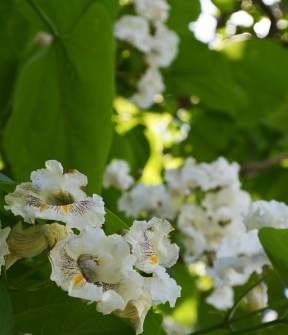
Delicate whipped cream,

the catalpa’s flowers stubbornly gripping strong branches

glowing among oversized leaves.

Catalpa flower6 062115

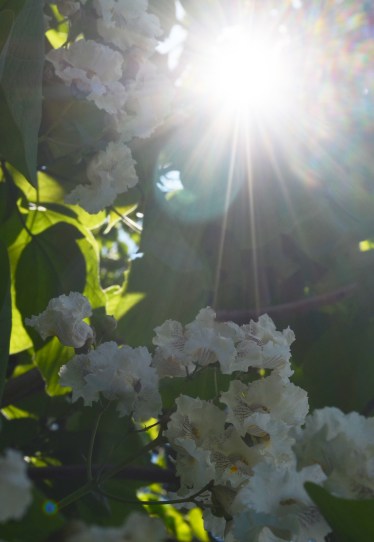
Flowers of art within,

palettes attracting bees’ background symphony

to nature’s gallery.

Catalpa flower7 062115

Like kindergarten parents reluctantly shooing children to buses,

the gnarled old trees releasing them

to parachute on the summer breeze.


In the grass,

whispering sirens’ music in the new summer air

their beauty seducing us to hold them.


Heeding their calls,

only for their molded cream to melt through our fingers,

reminding us how from strength can come life,

needing such gentle touch.

— Scott Schultz

Squeezed under summer’s weight

It’s easy this time of the year to feel as though things are closing in around us, nature itself getting a little too close to us for comfort.

Even the breath we draw in the morning has a closeness to it, the heavy mid-July air pushing heavy against our chests as we take in life-giving oxygen that’s still laden with the past day’s heat, and which soon will be steamed with the coming day’s heat. On a steamy July morning, what in other seasons is a freshness in the air can make us wonder whether this is what it’s like to breathe under a pile of heated bricks.

Barns are dampened with the inescapable humidity, the floors slickened to make treacherous walking for Holsteins and humans alike; haymows becoming rural saunas.

These, the start of the dog days of summer, are times when even the water down at the old swimming hole – that water that a couple weeks ago was so refreshing to our beings – is uninviting. And at beaches and pools, children’s feet are singed by sand and cement that have collected the very sun that they’re trying to avoid.

Even the smallest of critters, the gnats, “no see-ems” and skeeters, close in around us and push heavily against us. Any time outside, especially with the heavy darkness of the night-air’s lead-weight blanket pulled over us, requires age-old bug repellents that we’re never sure are good for us and always sure is uncomfortable for us. But we use the repellents in hopes that we can stop the unending swatting and flailing that has been so ineffective in pushing the critters away from us.

The shelters that at other times protect us from other seasons’ elements become either ovens that we don’t want to be in, or jail cells with cool air that keeps us trapped within. Front porches were built for times such as these; porch swings and rocking chairs invented for people who hope to find the margin between being trapped inside while still escaping the weight of the mid-July air.

Iced tea. Cold Coke. Well-chilled beer. A simple, refreshing glass of water on ice. All of which pour droplets of temple-cooling wetness down the outsides of containers.

We know to not go into the woods unless we absolutely have to, an excuse being to retrieve a renegade calf or the like. There, the gnats and skeeters that push themselves onto us in the open air seem minor to the thick swarms of biting flies, and an entomologist’s dream of other bug species that weigh down upon us. The deer choose the risk of cars’ headlights instead of remaining in the close confines of July’s bug-laden woods, so why would we want to go there unless we absolutely have to be there?

Though we don’t necessarily want to be in the woods, even a walk down some rural roads brings the woods to us. The trees, bushes, shrubs and ferns reach out to press against our space while we take morning or evening walks. That which will draw color-seeking tourists in two months are mere waves of deep green, an ocean reaching out to drown us in fauna.

Where other times invite us to the earth, July certainly makes the earth foreboding.

But then in the evening air we see sparkles of light that remind us that entering the depth of summer has positive values. Sometimes it takes watching the carefree and random movements of light from summer’s fireflies to remind us how summer also can make us carefree and random.

Just when we think the weight of summer’s air is unbearable, we can look to those fireflies and see the openness of a cloudless night sky – in it, so many distant stars that light escape routes to lead us away from summer’s earthly fires.

And unlike so much around us this time of year, we see the fireflies’ twittering lights moving away from us, each removing from our chests a little piece of the summer air’s burdens.

This time of the year in the countryside, if we allow summer’s weight the chance to buckle our knees, it certainly will. But with the spirit our rural fathers passed to us, we’ll continue to look toward the fireflies or any other little sign that this too will pass.

We know that a few short weeks from now will bring us new openings in the air, the soil and even the woods. It will again feel good to do physical labor, to be out in air that’s light and fresh. We’ll even get to see the daytime sky without the thick haze that July pulls across the horizons.

Like a robin’s song breaks a summer morning’s pre-dawn silence, we will break through the heavy cover that presses upon us in July. And then, like all other seasons, we’ll even bank some pleasant memories that we found when it seemed all was closing upon us.

Tailgating with Erling

When most people talk about tailgating these days, they’re referring to that wonderful practice of firing up grills in stadium parking lots to prepare for football or baseball games. It evokes great memories about heaps of Fourth of July-style food taking the forms of brats, burgers, hot dogs, ribs and potato salad.

There also is, of course, that less-savory tailgating, the sort when the driver behind you demonstrates the inability to remember basic driving rules – or thinks Highway 53 is a NASCAR track – and slides up to your bumper closer than 1960s teenagers at a drive-in movie.

I’ve been fortunate to be part of another version of tailgating, and fancy the thought that it’s tailgating at its finest: The rural-born method of dropping a pickup truck’s tailgate and sitting, usually arms folded across the chest, to discuss the truly important things that are going on across the county’s ridges and coulees. It’s likened to hunkering — that practice of squat-kneeling with a neighbor on a farmyard’s gravel driveway and stick-doodling in the gravel while talking about the day’s events.

One such tailgating session happened out at our farm the other day when Erling drove out to have a look at the property he still owns across from our farm, the homestead on which he was raised.

That afternoon started like any other day. I’d just been in my gardens, getting some daily exercise on the working end of a hoe, when Erling pulled into the driveway across the road named in his family’s honor. I roamed over to say a quick “hello,” perhaps knowing somewhere in my soul that there would be nothing quick about it.

We started by assuming the usual pose for a casual quickly-pass-the-time-of-day greeting, both knowing the time had grown too long between then and our previous tailgating session.

Erling didn’t break the discussion as he dropped the tailgate and took a seat on it.

I continued to stand for a bit because it’s a little-known tailgating rule that the younger of the people in the discussion should continue in the fully upright position until told or invited otherwise. On that day, my wait wasn’t long.

“Sit down for a while,” he said, pointing to the tailgate.

I did as I was told, of course, as much because I knew he’d share good stories as out of respect for the fact that he’d just passed his 90th birthday.

I’ve tailgated in plenty of stadiums’ parking lots in preparation for many sporting events. There were great and not-so-great discussions and bickering about athletes and teams during that tailgating, along with moments of jokes, laughter and general revelry.

As I sat on Erling’s tailgate, though, it occurred to me about how many times the countryside’s problems – the world’s problems, for that matter – could be resolved by any combination of a couple rural folks sitting on a truck’s tailgate and taking part in discussions between gnawing on a piece of grass, or tasting the sweetness of the red clovers’ blossoms.

It occurred to me how that was about the same way we met several years ago, sitting on the tailgate of that same truck and similarly rolling into a dialog about the countryside’s important issues.

We talked about the fox den we found in a culvert.

Birds, as always, were major parts of the conversation, us especially comparing how the orioles were acting this year at the farm and at his place down in Pigeon Falls and about how turkey vultures had set up a nest down the road from the farm.

We covered who was buying land from whom seemingly everywhere from Arcadia to Osseo, and shared our opinions about what might be done with that land.

He continued from previous tailgating sessions his descriptions of which trees he planted where, and reminded me that, many years ago, he’d planted the massive willow tree standing between our house and the road.

Our mutual never-ending attempts to stay ahead of the weeds in our gardens were high on our matters-of-import list, him intuitively reminding me about the importance of helping my wife process vegetables instead of me simply dumping them onto the kitchen’s counters.

And, of course, we talked about our shared love for the countryside and the need to care for it as much as it’s cared for us.

There was much more, of course, time races with a world-class sprinter’s speed when you’re in such a high-level tailgating session. Supper was waiting for both of us.

I walked into the house, my soul smiling.

The smile apparently was reminding me how good a rural tailgating session can be.

Perhaps a good entrepreneur could develop that goodness into a worthwhile project. I envision pickup trucks parked, tailgates dropped, spread across this northern Driftless Area soil. Signs would invite folks to sit together on those trucks’ tailgates and solve all the communities’ important matters.

It wouldn’t even require training. Tailgating in such purity is part of our rural DNA, after all.


Absorbing rural goodness from new perspectives

The gnats and other little insects so annoying on a mid-June morning stopped attacking my face as I parted the light brush along the pasture’s fence line. The bugs seemed to be taking the same curious pause taken by the cow standing a few yards across the fence from me.

None of those creatures likely ever had seen a person approach the pasture from that place. There were gates, roads, paths and lanes for that. It was senseless to be poking through the bug-infested brush on such a hot, muggy afternoon.

But there I stood, between some trees and the fence, looking out at the cow and whatever else I could see in the pasture.

Truly, the approach I took made some sense. The Angus cow is one of several owned by my neighbors and is kept at our farm and those neighbors’ adjacent pastures. The cow’s owners had asked if, while they were on a fishing trip, I would check on their cows. The afternoon previous I’d found one of the cows soon after she’d given birth to a calf.

The cow seemed to be having some post-calving difficulties, so my intent was to check on her the next day. When I saw her then, I looked for the best route to approach without startling her.

I hoped I also would get to see her calf.

Getting a closer view of the cow required a round-about approach to the pasture fence – a trek that included a couple stumbles on a decaying windfall and the incessant insect attacks.

Whatever minor inconveniences there were on the way to the fence went away the moment I pushed aside the last couple limbs between me and the barbed wire.

There, in front of me, was a view toward Timber Creek that I’d never seen. I’d been close to that spot plenty of times since we moved to the farm, but it struck me that I’d never viewed the couple-hundred yards from the top of the ridge down to the creek’s beginnings.

Life from the brush behind me and the pasture in front of me oozed into my widened pores and into every sense of my being. The oxygen dripped with honey’s sticky sweetness from the leaves and grass, tickling my nostrils while it surged through my cells.

A meadowlark’s tune carried briefly through the coulee, a couple of crows clumsily trying to add gravely harmony.

Though she stood more than 10 yards from me, the silence allowed the passing of the cow’s cud-grinding chew and an occasional deep breath and sigh from her flexing nostrils.

The cow was knee-deep in the pasture’s tossed salad of grasses, clovers and thistles. Her occasional single step or two rattled the salad gently across her legs, her heavy hooves splitting to grind the mix against the firm soil the same way her large, flat teeth were grinding her cud.

The pasture was still, except for the cow’s occasional sloth movements. But then, there was a wiggle in the middle of a taller spot of grass.

More stillness.

There. The movement in the grass.

Stillness.

Another wiggle. A flick, there.

The calf’s need to rid itself of some of those annoying bugs gave it away. Even in the best hiding places, the twitch of a calf’s ear echoes its location through a visual megaphone. The movement could just as well have turned down the sky’s house-lights and shone only spotlights onto the calf for all of nature – good and bad – to see.

And then, another twitch, in another patch of tall grass.

An unexpected sight, was that spotlighted second calf.

Twins?

The calves remained true to their hideouts until mammalian urges steered the cow toward them.

A few steps toward one of them, and then she mooed gently.

A few more steps, and then another gentle moo.

The calf nearest to her responded with a still-weak bleat, and then stood and did a newborn-wobbly stretch of its legs.

The cow and calf took the final few steps toward each other. Though the day glowed brightly, the instinct that drew them together made it apparent they could have done as well during night’s deepest blackness.

The calf stayed beside the cow as she started moving toward the other calf.

A gentle moo.

The hiding calf’s bleat in reply.

The second calf staggered to its twig-thin legs, just as the first had stood, and wobbled toward the cow.

Their snouts became their eyes, searching for the white treasure that stretched the cow’s udder. Near her middle, to near brisket and then back, the calves’ heads starting to bob in anticipation.

Finally, both found what they sought.

The birds having fallen silent, the calves’ sloppy sucking reached me in a hushed “thshuk, thshuk, thshuk, thshuk…” with the milk spilling down their lower jaws and onto their necks.

The feeding was short-lived, the calves soon each stumbling back to their hiding-spots.

They lie quietly, the only signs of them again an occasional ear-twitch caught through the grass. The quiet around them only was interrupted by the uneven, muffled sound of paper torn from a spiral notebook as the cow’s grass-cutting front teeth harvested nutrition for a later round of nursing.

The calves relaxed, sated by full stomachs and the cow’s motherly instincts. I relaxed, sated by a full heart and the land’s natural instincts.

Without crossing the fence, I was moved to lie on the pasture’s most comfortable spot, drifting with the puffy dinosaur cloud that I watched passing through the blue nothingness above.

A nearby crow in the woods called me back to mortality, alerting me that I was so comfortably leaning against a large oak tree I didn’t notice when I’d arrived. Insects resumed their incessant buzzing of all my senses, signaling that I’d devoured that day’s ration of the land’s nourishment.

There would be more on another day, but for then it was time to re-enter the material world.

I will return to that spot, which will provide a good place for reflection and to absorb all the rural countryside’s goodness. Though we’ve called this place home for a few years, I also know there are many more similar spots to be found here – some maybe only a few feet away.

— Scott Schultz