Walking with friends in the darkness

There aren’t many places where darkness is total these days. Lights of some sort always seem to be there, showing us the way through the darkest hours and filling the night sky with reflections of our human needs for light’s safety.

There’s an occasional moonless night on our farm, though, when clouds cover even the stars’ light. It’s not total darkness – something I believe is impossible to find any more in our lower-48 states – but on those nights it gets downright dark.

Such darkness is refreshing and pleasing to the eyes, in many ways.

We had one of those nights a while ago, me having to guess-and-feel my way through night’s thickness between our barn and the house.

The usual chorus of Timber Creek frogs and the dampness from a refreshing June rain earlier in the evening were amplified by senses sharpened by not being able to see my way. Even the normal petrichor of mixed post-rain ozone and soil hung more thickly than normal.

I stopped halfway between the buildings as much to allow my senses to absorb what the darkness offered as much as to gather my physical bearings.

Just then, a brief spark lit the darkness across our lawn. And then, another and another and another.

Like thousands of tiny camera strobes flashed by fans sitting in a darkened stadium, June’s fireflies came to life.

While watching those fireflies, I pondered whether most of my northern Driftless neighbors would admit to youthful summer nights of chasing fireflies across lawns city and rural, and looking with wonder at the complex creatures after capture. Who hasn’t poked holes in a jar’s cover and sprinkled the jar’s bottom with grass for a few captured fireflies?

Such lessons those captured fireflies taught. We quickly learned and re-learned how the fireflies’ survival was sadly short in those jars, and three or four fireflies in a jar could never replace a lantern.

Somehow though, that urge to catch fireflies stays with us, even as we reach our lives’ falls and winters.

That night, my mind created a picture of children young and old skipping crazed patterns as they followed fireflies across the northern Driftless Area’s lawns and pastures.

In my recent years, fireflies have come to mean much more than youthful summer skipping through the darkness.

Whenever our daughter Alyssa was away for summer visits with relatives or attending school or camps, my wife Dee and I sat silently while we waited for each night’s fireflies to appear. In those fireflies’ lights we saw Alyssa here with us, though reality has hundreds or even thousands of miles between us. It’s a tradition that’s continued even since Alyssa’s move into adulthood and her own home.

And in those fireflies’ twinkles we see other important people in our lives who aren’t here beside us.

“There she is,” Dee whispers as each night’s first firefly appears.

As more appear, we see our parents and ancestors beyond, my children Jessica and Jamie and their families, and so many others – some still bound by earthly mortality and others freed from earthly shackles. They dance and play around us with flickering gaiety inviting us to join in their other-worldly celebrations.

Most people look to the stars to see loves who aren’t beside them. That’s a great place to look during frosts of falls, winters and early springs, but not during summers.

On summer nights, craning necks aren’t required to see our loves in the stars above. Instead, during summer the stars above float down on fireflies’ tails to our rural soil, bringing with them light-shows worthy of all the heavens. Even the heaviest clouds in the darkest nights can’t hide their summer follies.

I continued through the farmyard darkness on that recent night, along the way enjoying the fireflies’ visit and determined to tell Dee about how they gave me vision in the darkness. I also considered how well a Helen Keller quote fit so perfectly with my short journey.

“I would rather walk with a friend I the dark, than alone in the light,” she said.

There with the fireflies, I was surrounded by friends.

Dee greeted me with her usual smile and hug as I entered the house.

“There she is,” she whispered into my ear while pointing to the small, flickering firefly’s light outside one of our windows.

— Scott Schultz


Oak-solid memories at the grand library of evolution

The old oak tree’s leaves rustled the mumble of a humble greeting fit for a being of such age, causing me to pause and look up at its arthritic-twisted trunk and branches.

There, in its gnarled bark, reflected the captured history with faces of the many generations who’d stood there before me.

“He who owns a veteran bur oak owns more than a tree,” Aldo Leopold wrote. “He owns an historical library and a reserved seat in the theatre of evolution.”

The twisted oaks on our farm up on Eimon Ridge have great stories to tell about this place’s people and its land. They have an entire Leopold library full of stories that include all that an old homestead can offer.

They’ve seen several generations of the Eimon family and a couple generations of the Larson and Schultz families enter the front door of the old farm house, which was built in the mid-1800s.

They’ve seen buildings rise and leave the old homestead, some of the spots where old buildings stood marked these days only by a piece of foundation rising out of the dirt or by a simple dip in the farmyard’s soil.

They’ve heard and seen countless gallons of sparkling spring water bubbling out of the ridge and down into Timber Creek.

They’ve seen the good times and the bad times; known wars with few spaces for peace.

They’ve felt the extremes of the Upper Midwest’s cold and heat; felt drought and deluge.

My brief stop under the oak came to mind the other day when one of our neighbors mentioned that they were likely going to take down the old red dairy barn on their family farm.

The reason has never totally been defined, but hearing those words always make rural folks step back and assess things. Few ever want to see the demise of an old barn, even knowing the removal is important for everything from aesthetics to function and safety.

Nostalgia runs thickly, good or bad, through the veins of folks such as us here in the northern Driftless Area. That’s especially true when we look at our beloved barns, which long have stood so proudly as symbols of all the hard work that happens on the soil of our ridges and coulees. All that happened on the land was done in homage to those barns.

I think back to the barn built on our old home farm over at Veefkind, and all that building has meant to me. It was built with beams hand-hewn by Henry Borne Veefkind, my great-great grandfather. A day will arrive, I realize – perhaps yet in my lifetime – when that barn also will have to be removed from the landscape.

Should the old Veefkind barn be razed in my lifetime, I hope to save at least a few splinters or even an entire piece of its beams to occasionally touch. Such a thing would be my way of linking the spirits of six generations of my family who’d also touched that hand-hewn timber.

I suspect my neighbors will do something similar, if they decide to have their old barn removed.

Whether I ever get a piece of the Veefkind barn’s beam or whether our neighbors keep a few pieces of their family’s old barn is inconsequential in the big picture, I suppose. Our ancestors who built those structures left behind structures much older than ours to find new soil to mold and nurture.

Though important to so many of us, the nostalgia we feel about those barns will pass with our own demise; we being but blinks in time’s eyes.

What goes on here is of some import to those of us who reminisce but, after our short stays, only the soil and those old oaks will be left to decide what was important.

Someone a couple generations from now will look into that old oak’s bark and see its memories of our short presence. In it will be the structures that were built and then disappeared, dreams realized and dashed, and hope lost and found.

And someday down the line, even that twisted old tree will be but a memory added to the soil.

— Scott Schultz

Comfort in the Haze

That night’s rain and dew made the soil cry teardrops beaded on the May morning’s grass. Thick fog that had hidden in the night’s darkness was exposed by the morning light diffused by the fog on the eastern horizon.

No tractors disc harrows, grain drills or corn planters would massage the northern Driftless Area’s hillside farmland that day. There would be no din that’s the rumbling of trucks hauling fertilizers and herbicides.

There would be no smell of freshly cut grass that day, because no lawns would be mowed under such conditions; the tulips and dandelions would hold their petals closed in wait for the sun to find its way through the fog.

School playgrounds likely would be empty of joy, their normally enthusiastic clientele remaining within indoor climes with warmth and dryness the outside air wasn’t providing.

Even nature’s voices were muted by the blanket draped low between the soil and the sky – songbirds ever-present and recently arrived not finding the notes to brighten the other creatures’ spirits.

There was no spring morning bounding-for-joy prance in the calves’ legs as they rose to suckle their dams in the pasture, their approaches instead dutiful strides.

The air, that blanket of fog and haze pulled over us from Osseo to Trempealeau, seemed to be closing in to stifle and suffocate all that’s May.

But then, something seemed to change in what the day was bringing to me as I crossed the farmyard and entered the creaky old house here at our Eimon Homestead farm. The feeling of being stifled and suffocated shifted to the feeling of being lovingly hugged.

It wasn’t one of those hugs that old friends give after long separations, those that threaten to break ribs and most often include hands pounding on backs; it wasn’t that sort of head-spinning hug of passion that entangles lovers.

The hug I felt was more like that of a mother comforting her young son after he skins a knee; the hug was loving trust passed between a long-married couple.

It was a hug of comfort, telling me all was safe.

The feeling made me smile as I went to my office in the southwest corner of our house, that place where I’ve long felt safe to allow words to pour from my fingers. There, I looked out at the farmyard and at the old willow while contemplating the newly realized feeling of that foggy blanket’s hug – ignoring echoes of my parents’ long-ago admonitions that I shouldn’t think so much about such matters.

I considered how I’d so often been finding such reassurances in this corner of the Driftless Area, whether it be while looking over a lock-and-dam on the Mississippi, sitting beside a spring-fed creek, meeting with folks at the café in Whitehall, snacking on chicken gizzards in Independence, strolling the shore of the mighty Pigeon Pond, getting my hands dirty with a few hay bales or in this ridge’s soil…. Oh, so many times I’ve felt such reassuring hugs from this land and its people, whether it be night, day, cloudy, sunny or – as I’d learned that morning – under the heavy comforter that was a foggy blanket.

My contemplation was broken by a bright flitting around one of the bird feeders near the office’s window. It was a newly returned oriole making the season’s first appearance.

And then, there was another oriole – and another and another and another. An entire little flock of them were making their much-welcomed return to their old summer home.

Moments later, I glanced up to see a hummingbird sitting on one of the feeders we keep on the house’s eaves. Undoubtedly exhausted from such a long migration, he seemed to inhale nectar while the words “welcome home, my little friend” crossed my lips.

By the end of that day, I’d feel the comfort of having our entire Eimon Ridge family all within our farm’s safety. I hoped all felt the place’s and land’s embrace as I was feeling it.

The hug continued and has yet to set me free. There might be times when a spirit might feel the need to be released from a hug but, for me, this hasn’t been among those times.

I needed such an embrace, that of the sort different than those given by those with whom we share the greatest love. The sort of hugs given by this place and its land reach into you and love-spackle any chips and cracks life has left on your heart. Knowing such a slight difference between the warmth of human hugs and the land’s hugs is like knowing the differences between a lover’s hug and a mother’s hug.

Comfort comes in many forms.

It’s taken me longer than it should to realize that, around these parts, warm and comforting hugs of safety are easy to find even within what might seem like the most dreary days. Though not always quick to remember that, I’m certain to find reminders when I look at the comfort it gives wife Dee and all those creatures come home.

— Scott Schultz

Glories in the Gallery

I stopped in my tracks out in the farmyard to watch the eastern horizon starting to blush.

Standing in that spot or thereabouts is something I’ve done often since we’ve lived out on this ridge, me facing the east to watch such blush of pink appearing with sunrises — the reds and oranges and goldenrod yellows soon following.

But that was a moment of the sun’s rising. Instead, it was setting.

The matter caused me to do a double-take of sorts, momentarily worrying that the onset of another birthday brought confusion about which direction I was facing. I assured myself that I was, indeed, looking to the east.

What then, was causing this colorful eastern sky?

A quick consideration crossed my mind that perhaps the large greenhouse operation over by Northfield to the southeast already was casting its purple light-reflection off the light clouds Sunset2 061317streaking that part of the sky. But the eerie colored light pollution we’ve come to know during the past few months – a phenomenon to which we’ve become somewhat accustomed and which startles the unknowing – wasn’t the cause.
Something from behind told me to turn around, where I realized the cause.

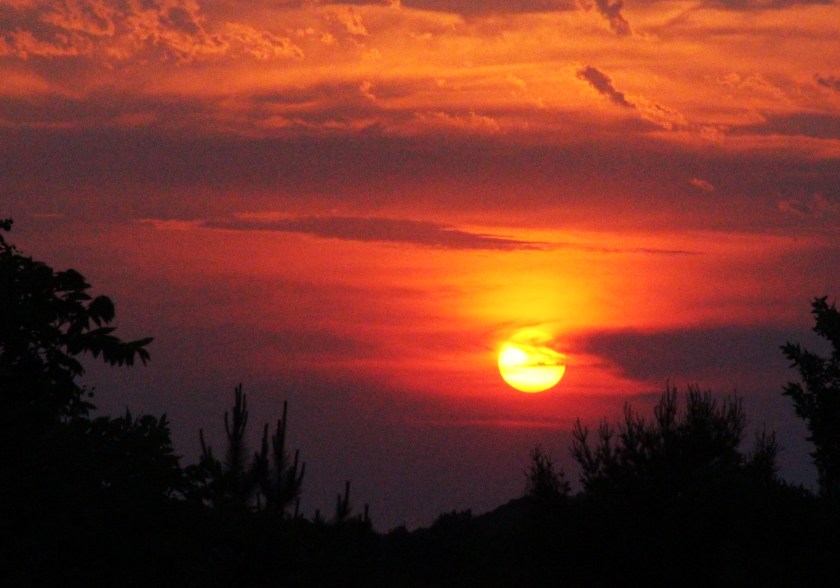
The sun settling into its evening resting place along the western horizon was putting on a light show that rivaled any I’d seen at any point in the world I’ve gotten to know.

Such sunsets have occasioned us here in the past, me committed to never take for granted such art. But seldom have even the most spectacular sunsets splashed the entire sky with all combinations in the color-wheels; all the paint-cans’ covers jettisoned as the hardware stores’ mixers were quaking in their greatest violence.

Glances back and forth, west to east and east to west, I turn to watch the morning’s horizon and turn to watch the evening’s horizon.

What souls have stood on that spot over the years, getting the same show? This soil has told me that those here before me definitely had stopped to see similar spectacles, no matter how busy the day and no matter whether it was time for the cows to be milked.

That hasn’t been the case in all places I’ve been over the years, but it seems to be something that’s a habit in these parts — most folks I know around here being the sorts to have stopped and watched as I watched.

As yet another northern Driftless Area art exhibit drew to a close, I went into our old farmhouse and anticipated the many stories and images I’d be hearing, reading and seeing in the exhibit’s critique. There likely only would be positive critiques, I suspected, those attesting otherwise having little understanding of our fortune for having an artist so renowned show her best work in our humble gallery.

Those critiques didn’t offer any disappointment, them being plentiful and positive.

In other venues, they’d include audiences in standing ovations uproariously applauding with yells of “Brava!” Here though, the ovations were in the form of friends’ texts and calls to ask whether we’d seen the exhibit; they were in social media postings in words and photographs.

We’d seen similar shows but didn’t know whether they’d ever be matched and certainly didn’t think they’d ever be topped as they were tonight, we so many agreed.

This has to be one of the most incredible pieces of countryside to live upon, we so many contended.

“How could this ever be topped?” we so many asked.

“This season has painted our senses with sunrises and sunsets,” we so many spoke the obvious.

We gave thanks for the show, we so many the thankful.

Dusk closed the gallery, and we looked away as darkness drew its curtain over the show; bright gallery lights were replaced with twinkling stars’ security lights.

Like the gallery’s security guard, I made one last visit out into the darkened venue. And there through a wispy cloud’s haze shined that night’s moon, it in a half-winked bedroom-eye dreaminess.

It’s always wonderful to see the artist installing her next show.

Brava, dear artist of this soil. Brava.

— Scott Schultz

Gauging Small Risks

Life is full of risks; a notion experience seems to teach us as we head deeply into our personal fall seasons.

I’ve taken on plenty of risks in my day – too many, I’ve been told by some folks – and will continue to take them. Some of those risks have been grand; some of them have been small. Some of them have brought joy and successes; some of them have brought sadness and losses.

Most of the risks I’ve taken are tales for another time and another day. But one of the small annual risks I take is bigger than it might seem or sound, making it worthy of a few words.

That single, seemingly small risk, after all, challenges nature itself: that time each year when I turn my glass rain gauge right-side up.

Not everyone will understand what I’m talking about, and some northern Driftless Area folks might take a similar risk by taking their glass rain gauges out of storage – those folks using the greatest caution with such a valuable instrument when the previous fall’s weather turned icy.

Though rain gauges are relatively inexpensive instruments, plenty of us carry a long-established rural gene which gives us the unspoken challenge of seeing how long we can make a rain gauge last.

Those who know the challenge know that the rain gauge needs to be turned over or stored when winter weather approaches. Doing otherwise would allow some water to get into the rain gauge and freeze, the freezing water’s expansion breaking the gauge.

I painfully learned about the science of that freezing-water-in-the-rain-gauge long before ever stepping into a school’s classroom. It was taught at my father’s hands on that long-ago spring day when my father went to turn his rain gauge right-side up for the warm season.

Dad was making his way from the barn to the house after morning chores that day, his little redheaded sixth child doing his best to keep up. Along the way, Dad stopped at the post on which his beloved rain gauge told him how much rain had been feeding our pastures and crops.

He reached his farm-gnarled left hand and plucked the rain-gauge from its holder.

His jaw muscles tightened as he pensively stared at the bottomless glass cylinder.

He turned and looked down at me, his nostrils flaring.

Some sort of question came through his clenched teeth, but I wasn’t sure what he was trying to say.

“Huh?” I said with all the 5-year-old innocence I could muster.

“I said, did you turn my rain gauge over?” he somehow hissed through his still-clenched teeth.

I smiled and straightened my little body and proudly answered, “Yes! Somebody turned it upside down last fall, and I knew you’d want to know how much it was snowing!”

His left hand still occupied with the now-worthless piece of glass cylinder, he reached his farm-gnarled right hand to his seed-cap’s bill and, with one uninterrupted motion, pulled the cap from his head and swiftly lowered it onto the top of my red hair’s cowlicks. The cap, well-oiled by several years of him leaning against Holstein’s bellies, cracked like a lion-tamer’s whip across my skull.

No further explanation was needed, and none was offered as he strode with anger toward the house for a bit of breakfast and to undoubtedly tell my mother that – for the moment – he’d have been happy if they’d stopped at five kids.

I walked across the farmyard the other day here at the Eimon Homestead, and stared at the upside-down rain gauge on a post near the milk house. It was the middle of April, and it hadn’t been freezing much at night. I reached my aged left hand to it, giving thanks that no 5-year-old had done what I long did to my father’s gauge, pulled the glass tube up and reinserted it open-side up.

I reflexively flinched, waiting for that well-worn seed cap to fall from the heavens and crack me across the skull. It didn’t, so Dad must have been OK with me taking the risk.

That night, I drove from a meeting in Galesville. The dark sky opened in a downpour of nourishing spring rain – so much that I had to slow my truck because of the reduced visibility. My knuckles tightened around the steering wheel as I deepened my concentration on driving through the storm.

And then, a smile came to my being –a smile of satisfaction in knowing my risk would allow me to tell folks how much rain we got that night up here on Eimon Ridge. As I drove through Whitehall, Coral City and Pigeon Falls, I wondered who else might be sitting in their northern Driftless Area homes and smiling about their risks paying the same dividends.

— Scott Schultz

Spring Snow Angels

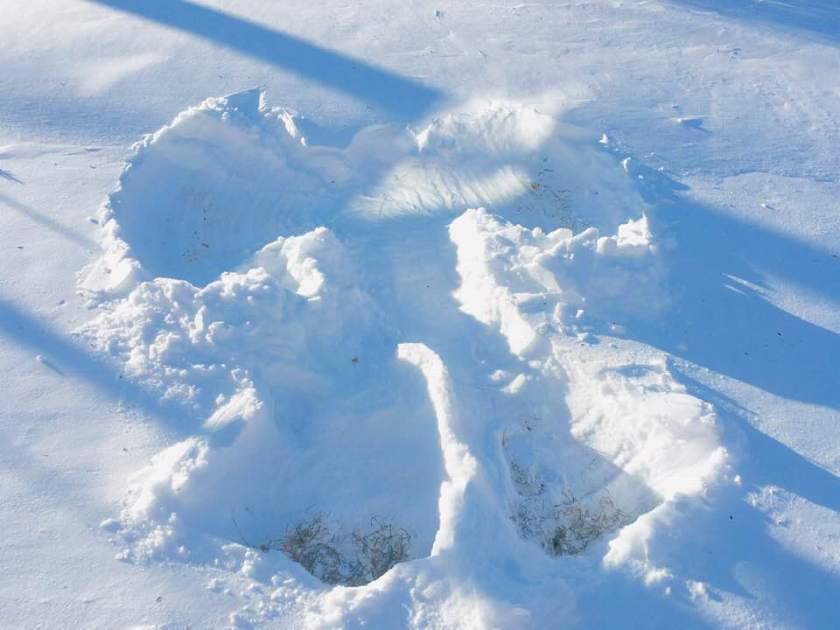
Snow angel
There was good reason for pause the other day when a mid-morning snow-squall suddenly whitened our countryside.

It was worthy of the stop, besides the fact that a momentary white-out made it safest to pull my truck into a central Wisconsin driveway.

The white-out was brief, and it became safe to again get back onto the gravel road and make my next appointment.

I backed out of the driveway to be on my way. But once back on the road, I again brought the truck to a halt.

The sight was too good to ignore.

What started as the squall settled into a snow-globe shake of the countryside: large flakes’ fingers extended to reach toward other flakes to join in their slow waltzes to the sod and gravel embracing me from all sides.

The scene brought a smile to my face, me knowing many of my favorite curmudgeon-friends would be complaining about the soil being covered in snow’s bright whiteness in April, which isn’t their idea of spring.

I silently practiced my response that the weather is going to do what the weather is going to do – and that, we can’t change the weather no matter how much we might complain about it.

“I don’t like much that it snowed in April, either,” I’d tell those curmudgeon-friends. “But the way I see it, we have the choice of whining about it or making snow angels. I always choose making snow angels.”

My cheerleading would be ignored by the most dedicated of the curmudgeon-friends, I knew. There’s no changing the minds of folks who can’t find the good in what the countryside offers, even when it’s a spring snow; those same curmudgeon-friends would have been complaining that it’s too hot and the mosquitoes too thick if the temperature instead was 80 degrees.

There was another moment when I considered whether the old farmers were becoming upset because of the unseasonably cold weather and that morning’s snow.

Somewhere, I knew, someone was changing a tractor’s oil in a machine-shed shop. Someone wearing coveralls not far from me was greasing a disc harrow or corn planter in anticipation of working warmed soil.

And somewhere near was an old person of the soil who joined my appreciation for that spring snow – them the makers of snow-angels at heart, if not literally.

It’s the snow-angel makers who first appreciate that snow-globe waltzing of the snowflakes, even when the spring sun is starting to reach high into the sky. Those are the people who understand the help the reaching fingers of large, spring snowflakes give soothing massages to the waking spring soil.

The snow-angel makers listened to the old-timers who said the gentle melting of a spring snow massages its nourishment into the still-cold soil.

Cold spring showers are nice, a snow-angel-making old-timer told me, but that moisture too quickly sleds across the land and into Timber Creek and the Yellow River and the Trempealeau River and the Black River.

Spring snow invites the soil into a close slow-dance that has the soil inhaling the melting moisture into its depths.

Something inside of me spurred an urge to jump out of the truck and flop onto the snow in one of the fields along the road. My snow-angel being wanted to join in the massaging and dancing going on in the field.

It seems people look strangely upon old guys who remain farm kids at-heart. And the pace of our days’ lives doesn’t necessarily allow the time for such things.

Instead, I remained within my truck and pulled it into gear to move down the newly whitened road.

I drove along my way hoping someone out there really had the patience and time to make a snow angel, just as the spring snow was being patient and spreading needed moisture into the soil.

— Scott Schultz

A Winter Eulogy

­­­­­…In the spring a fuller crimson comes upon the robin’s breast;
In the spring the wanton lapwing gets himself another crest;

In the spring a livelier iris changes on the burnish’d dove;
In the spring a young man’s fancy lightly turns to thoughts of love….
— Alfred, Lord Tennyson, “Locksley Hall”

Lord Tennyson’s words are among the classic introductions to spring, which the calendar has brought to us upon the wings of a cool breeze and the vernal equinox.

Few are the words, though, that honor that last day of winter – the day some might feel best forgotten.

We tour the town and the rural countryside to seek the words and scenes fitting to adequately honor the old winter’s last day.

It’s that last day of winter when school students still are wearing snowsuits and aren’t allowed out for recess without their boots. It’s still winter, after all.

It’s that last day of winter when people still have to bundle up to take their dogs for walks, do their farm chores or otherwise carry on with daily outdoor duties.

It’s that last day of winter when an American Legion bugler has to find his ear-muffs to add his mournful 24 notes of Taps to the breeze during a departed comrade’s last earthly honors.

The grass has found its way from under the snow by the time winter’s last day arrives. And so much forgotten during winter reveals itself on that last day.

Piles of icy snow remain, their crystals signs that the snow is finally relenting to March’s high sun.

Sitting behind the window of a house or a barn or a pickup truck might fool us into thinking spring already has made its visit. We venture outside to realize the sun’s intense glare reflected off the remaining snow, which momentarily offers warmth. But after a few moments, that solar warmth is pushed aside by winter’s last breeze pulling chilled goosebumps from the ice and depositing them on our skin.

I’d been away from our farmyard for most of this last winter’s day, only to have seen it playing out in those aforementioned ways. The chill settled in the goosebumps the wind had deposited onto me – in great part because I’d dressed for a spring day instead of a winter day. A lament of foolishness about my clothing choice swirled in my mind when I happened upon the Leopold benches parked under the overhang on the west side of our old farmhouse.

The sun by then had passed its noon midpoint and started its late-afternoon journey into the western sky. Its full March warmth found me at those benches, which our old house’s angles were keeping out of the wind.

And there, the sun offered a eulogy for winter and prepared for the morrow’s baptism of another new spring. That last day of winter was reluctantly passing the season’s torch on to spring’s warmer days.

I took my place on the Leopold bench to ponder for a few moments the passing of that winter and of spring’s arrival. There was some joy in the seasons’ exchange; there was reflection and wonder in how there got to be so many such exchanges during my lifetime.

Where has winter gone?

What will spring offer?

When did those many seasons catch up to my being?

There on that bench, I found solace in having known so many winters-turned-springs.

There on that bench, I took joy in the fortune of having been given so many winters-turned-springs.

All the birds that stayed at our farm through the depths of winter’s snow and cold likely would remain through the seasonal exchange. In a few weeks, they would be joined by those birds and butterflies and bugs that prefer only warm seasons.

The neighborhood beef cattle-, horses- and deer-in-residence soon would graze in pastures green.

The trees would bud and leaf; the flowers would sprout and blossom.

In a few weeks, tractors and planters would take to the northern Driftless Area’s fields. Gardens would be planted in anticipated of homegrown bounties of goodness.

An old friend once told me that Aldo Leopold had designed the benches named for him to be a bit uncomfortable so as to not hold wanderlust-filled spirits in contemplation too long in a single place. Honoring that, I rose from my bench and moved on to the next chore.

With me moved winter’s last light and its wind’s last whispers through the farmyard trees’ branches. The moon, which on coming equinox would be full in celebration of the new season, was glowing in the east.

I honored the eulogy whispered on the wind, but mourned only for the aging in my own bones marked by its passing.

There was respect in my spirit for winter’s time here, but I’d shed no tears. Instead, I silently promised myself only a return to that bench the next day to join the full moon in celebrating the new spring.

— Scott Schultz

Quietly riding an early March wind

We were sitting quietly in our old farmhouse late the other night, me reading a book and Dee grading some of her students’ papers, when a strong gust of wind snare-drummed our big elm tree’s twigs and blew flutes’ melodies through the pine trees’ boughs.

The wind’s sudden symphony caught our attention enough to make us stop what we were doing and look at each other.

I was the first to break the warm silence that remained in our sanctum.

“Do you know what that was?” I asked.

“The wind,” she answered.

“No, I mean, do you really know what that was?” I pressed.

“Yes. It was a gust of wind blowing through the trees,” she smirked.

A moment passed before I realized that she, the teacher, was challenging me, the student, to share another romanticized description about something so simple as wind gusting through our farmyard’s trees. Seldom in our house do such simplicities go without some sort of expansive interpretation, us believing life and this gorgeous countryside deserving at least that much in return for what we receive from them.

Though having spent much of her life in Florida’s warmer climes, it didn’t take many years of living here for Dee to realize there’s likely great meaning riding bareback on that gust of wind.

It was early March herself spurring that wind into full gallop, whoopin’ and hollerin’ all the way over our ridges and coulees, starting here at Timber Creek, going down to Pigeon Creek, whipping across the Trempealeau and not even letting the Old Man River stop her.

In her wake were scattered assurances that winter’s demise draws nigh. The below-zero ice she carried that night to rub cheeks rosy will, within a few days, thaw into rivulets wending down the ridges to feed pastures wild and tamed.

The March wind’s ride stirs our Northern Driftless Area’s ridges and coulees in ways that leave all unsettled for weeks – nature herself calling out trees’ buds while accidentally dumping a few inches of snow to remind us of confusion that wind wreaks.

Children of all ages will be tempted to fly their kites on March’s wind, though its fury threatens to tear any kite from control and carry it the miles from Galesville to Pigeon Falls.

In the March wind, city street workers hear it tell them to keep street sweepers and snow plows handy at the same time.

It thumps spring’s Morse code on the metal of farm’s machine sheds, telling farmers to get harrows and drills ready, though the ice-box cold shed interiors belie the March sun’s warm massage on the exteriors.

Because of that wind, there will be days when thermometers say it’s freezing at the same time the sun warms us and melts the driveway’s ice and snow.

Sap will tap slow daytime rhythms from spiles in trees still frozen at night.

On the March wind, robins will join to ride with April showers toward its promise of spring’s warmth, only to search for cover in bushes and boughs when snow salts their backs – three times, the old-timers say.

Dee and I took our time considering how that early March night’s gust was so much more than a gust as we might hear in any other month. And then, through her teasing wit-filled smile, Dee said, “I think what we heard is all of those things. But tonight, it’s just the wind blowing in our trees.”

She used her forefinger to push her spectacles farther up the bridge of her nose and, still smiling, returned to grading her students’ papers. I searched for the spot where I’d left off in my book and continued reading.

Though we busied ourselves with other things, we silently listened to the wind, without words acknowledging each gust of that night’s wind so unimportant and so important.

— Scott Schultz

Days of Blue Shadows and Diamonds

My note was a simple one that I had to send to my friend who’d spent so many of his years here on this farm we call home. And, when I say I had to send it, I mean that I really had to send it – my spirit not allowing anything less.

The note was about the diamonds glistening across the snow-covered landscape on that winter day; them gleaming even in the light reflecting from the previous night’s full moon.

It had been an amazing couple of days and nights of sunrises, sunsets, moonrises and moonsets on this northern Driftless Area ridge. On the morning I sent the note, I stood in the farmyard’s chill watching the giant-pumpkin fool moon descend over our silo and barns to the west while the coming sunrise painted a red glow to the east. My only option was to face to the south and keep turning my head east-to-west and west-to-east to watch such a grand celestial show.

As I wrote the short note to my friend, I couldn’t imagine anything that could add to what I’d been seeing. But his response did just that.

“It brings out what I always described as blue shadows on the snow,” he replied.

That friend, Erling, had spent many of his 90-plus years of life considering about the blue snow and other wonders about this soil. His reply made me smile.

I smiled because I enjoyed his observations.

I smiled because I’d often noticed those blueish winter shadows on the snow.

I smiled because I didn’t know scientifically why the shadows appear to be blue on a sunny winter day, and that I don’t care to know. I’ll simply enjoy the blue hues.

I’ve written about the rural countryside in many ways over the past half-century, and at that moment it struck me that I’d never written about how shadows cast upon the snow have such a blue tint. I’d seen it my entire life and recall thinking about it often during my youth.

A sort of sadness washed over me that I’d left those blue shadows out of my thoughts for so many years. The reply and the blue-shadow memories it brought carried me on a back-and-forth ride on the chronological rollercoaster we ride through life.

I allowed the rollercoaster to reach the flat part of its track and slow for a bit before I reminded myself about the importance of not taking for granted those things so simple as blue shadows. Those shadows, after all, help show us the way to all that’s life around us – here at the farm the big willow’s grass-skirt dance in the chilled breeze, and the stillness of the catalpa trees’ bared branches; the cardinals and finches flitting with doves and blue jays among the farmyard’s bushes. They show us the way to the stiff winter movements of the cattle around the barnyard and barns; to the whitetail doe passing through the field across the road.

The blue shadows are the snow-covered soil’s connection with all that’s bright in the sky.

There was a time when I might have turned away from my reflective spirit and paid attention to my curious spirit to answer the question about why the shadows turn so blue when they’re made on snow. A strange thing has happened as I’ve aged, though; I’ve taken to not concern myself so much with the need for such an answer, instead simply enjoying the blue-shadow show.

I’m happy for that exchange of notes with my friend, because it’s going to give me a new way to look at life as I move through the countryside.

The blue shadows will be part of my days whether I’m at Arcadia or down at Trempealeau; whether I’m at York or at Pleasantville.

I’ll consider the renewal in my awareness about blue shadows to be a special gift from my friend whose legacy always will leave such wondrous blue shadows here on our farm. And, for the new year I’ll resolve to look at more blue shadows during my journeys whenever snow’s quilt covers our soil.

There being something new for my senses to take in has been a constant during the short decade since we arrived among these ridges and coulees. I have no doubt that watching how the blue shadows play among the diamonds reflecting from the snow covering those ridges and coulees will be exciting to see, now that I’ve been reminded to look for them.

— Scott Schultz

Treasures of the Land

There was much to do around the farmyard this morning, it being one of those days when the air had enough chill to remind me that it’s January but the sun warming enough to tease me with a spring morning’s comfort.

I’d been out the previous night, gazing into the winter’s stars in wonder of what riches the coming year might bring. Most such clear January nights have brought crisp and deep cold to our rural countryside and my spirit, but that night gave in to allow yesterday’s warmth to continue visiting for a spell.

The morning invited me to the barnyard for a lean against a fencepost to visit with the cattle, them nodding their heads in silent agreement with the weather, the silence interrupted only by an occasional clack of a hoof against a clumped piece of frozen barnyard sod or by the crunch-groan of the cud being ground by a cow’s circling jaw. The cattle and I were getting along fine when I felt the sun starting to gently run its fingers up and down my back, settling onto my shoulders to start a deep massage into muscles knotted by days, months and years of life’s give-and-take.

The cows disappeared onto the other side of my eyelids as I allowed the sun to lure me with its touch. And then, the sun leaned around to my ear and siren-whispered, “take my hand and saunter with me; I’ll show you the land’s treasures.”

My spirit fell prey to the invitation, and together we sauntered along our beloved northern Driftless Area ridge. I wanted to know what more treasure there could be here, me believing the treasure already being in creation allowing this area to be untouched by glaciers. Such breathtaking vistas were given for us to tread upon and gaze down into the coulees below.

“The treasures are great,” the sun whispered again as we strolled shoulder-to-shoulder and arm-around-waist up the ridge’s road. “Look and seek; its wealth will be yours.”

The road’s stones crunched in musical rhythm with each step as my eyes roamed high into the deep azure sky and then down into the treetops. Art was on display all around the land’s winter gallery: in the deciduous trees’ leafless nakedness, the birches’ white brightness contrasted with the darkness of oaks, maples, and walnuts, and against the evergreens’ green hues. Grasses of winter’s brown or still holding onto greenness poked through the smatterings of snow in the woods and fields. Broken corn-stalk reminders of gardens and fields reflected in the morning’s brightness.

And then, there in the oaks I noticed the reflections from the bronze-gold leaves that refuse to let go from their branches through the winter, me seeing a hint of treasure the sun’s siren-whispers invited me to see.

“Is that the treasure?” I asked.

“Some of it,” she whispered. “But there’s more. Much more awaits your eyes.”

I looked more deeply within the trees. Among them, I saw grasses I knew would be bringing new life in the spring; I saw hints of the fallen autumn leaves’ colors that are replenishing the duff’s investment in future growth.

A bird’s flitter in a roadside apple tree caught my eyes, the ice-sweetened apples still hanging from branches providing winter riches in energy for the many birds that would flit their way through cold air to find refuge among the branches.

I felt the sun’s hand moving up and down my back to offer some knowing comfort.

“I think I’ve seen the treasures,” I said.

“Not all of them,” the sun whispered through its warming smile. “There’s more. You must see the land in all ways.”

But what more could there be? And where would I find it? I’d looked high into the sky and then to all the land around me and already seen so many treasures.

Where else could I look?

I sought solace and answers in the rhythmic crunching of the road’s small rocks under my feet. And there, I found the day’s most special treasure.

Trees’ shadows were laddered across the road, providing my feet a lift while I made my way up the steepest of the ridge’s hills. Frost left from the night’s dampened darkness covered the road with white, the sun choosing to allow it to remain for my eyes and spirit to behold.

It was there that I saw the treasure of the previous night’s stars having fallen to the land for me to see – guiding my path with sparkling brightness as I’d never known. No earthly gems created by the land or the creatures of its soil could match the beauty of their treasure.

I followed the path they marked for me until I reached the highway, where human life interrupted nature enough for the treasure to again hide itself. But when I turned around, I saw that the sun would allow me to see the treasure of such value as it guided me back to the farm.

The sun pulled me into its arms and held me closely as I started my saunter toward home, gently pressing its face against my cheeks in sensual warmth. I felt its heart beating against my chest and then work its way into my chest, where it wrapped itself around my heart to hold it in the perfect way.

We loosened our embrace as I arrived at the farm, the sun’s hand tickling my palm as I stepped into the buildings’ shadows.

“I’ll be here, waiting to show you more treasures,” the sun said, leaving its warm kisses on my cheeks.

Some might say the siren sun’s offer of treasure was empty – that it showed me no treasure of real value and which couldn’t feed us, house us or warm us. But those riches fill me in ways that go beyond any material form.

The treasures I found while sauntering with the sun filled my spirit in ways only those who’ve known the soil can understand. Such treasures have been on this ridge since the beginning of time, and fortunate are those who understand the richness in finding them.

— Scott Schultz