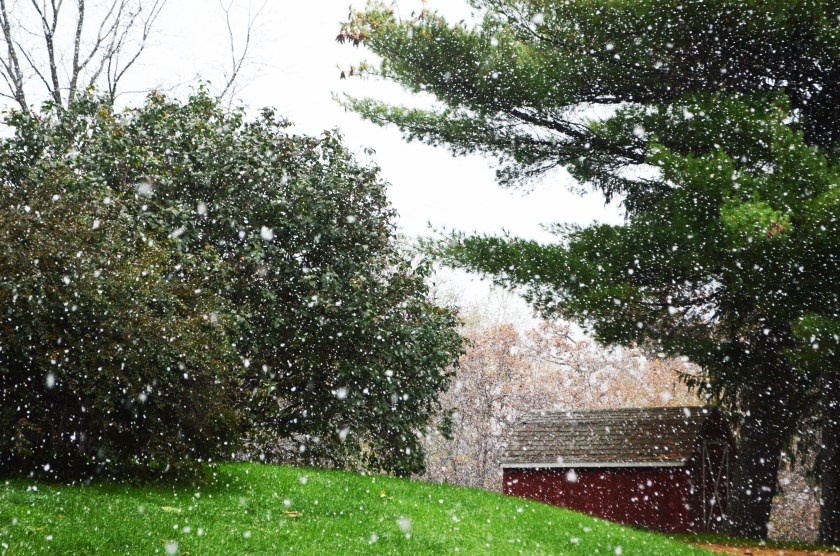
October’s winter tease
The scolding I received the other day was loud, incessant and sure, telling me I’d walked into a place where at least one being thought I was unwelcome.
I’d heard such scoldings ringing from trees in woodlots throughout the countryside over the years, this time of year those blue jays for whatever reasons seeming to be particularly concerned about who walks in their territory.
The jay’s noisy announcement of my approach that day didn’t matter as much as it has on some other occasions; that day my being there only a time to breathe in the fall’s colors and the special smell of the woods’ damp autumn duff. There have been times when I’ve tried to stalk through the woods during a hunt only to have a jay unnecessarily flapping its beak to announce my approach to every creature in the section.
Something about that blue jay’s yelping scold gave me a feeling of comfort, though. It took a bit of consideration but, after a while, I realized it was because that old blue jay still was there to yell at me.
We’re abandoned by many of our friends this time of the year, those of pretty feather and song flitting away to climes south. I look up at my humming bird feeder hanging lonely in the eve, the last humming bird having sipped its nectar a week or more earlier. I’ve left those feeders hang with the chance that a late-migrating humming bird might be passing through and need a little jolt of sugar-laden water.
Out a little farther from the window, oriole-feeding stations sit emptied for the season, the orioles having departed long before the humming birds’ departures. My wife Dee will be happy to know that I’ll again be using more grape jelly on my toast than I’m feeding to the orioles.
Even the finches are visiting less, me missing their golds and reds flitting across the feeders with colors that blended so well with the lush grass below.
The blackbirds have long ago departed, having flocked loudly on bent and dried corn-tassels before their sudden quietness a sign that their wings would explode into a collective whooshing and their disappearance until spring.
The robins, those quirky wonders that seem to show up when I least expect it. There hasn’t been one around for a bit, but a straggler or two always seems to stop through after the season’s first snow falls – them apparently suddenly waking to the notion that getting drunk on late-hanging berries and apples might not be as important as staying warm.
But then there’s that blue jay, that bully of a bird that can be so loud and obnoxious; its brightness not denied though its heart seeming to be filled with anger. He and others like him will remain around the woods and the farmyard, continuing to be visitors around my feeders even as the old willow weeps its tears of golden leaves and as we see the first white flurries fall from the clouds.
The jay, the cardinals, the woodpeckers, the nuthatches and the sparrows will continue being here for me, reminding me of so many of this northern Driftless Area countryside’s people.
Summer’s fun and pretty songbirds will flirt and sing here for a while and then be gone, to return at their whim when the weather’s warmed. But that special group will be here for the duration, giving me their own measures of comfort whether in summer’s swelter or winter’s freeze.
Erling, whose family homesteaded and caressed this land for several generations, once reminded me about the story of the little girl who a grownup asked which bird — among all the pretty birds at the feeder – was her favorite. The adult was taken aback when she answered, “The sparrows.”
“Wouldn’t one of the birds that’s so brightly colored and sings so nicely be better?” the adult said.
“No, those pretty birds always leave. The sparrows are always here for me,” the child said.
Thank goodness that this land, this northern Driftless place we know as Trempealeau County, is so filled with those sparrows, nuthatches, woodpeckers and cardinals.
And yes, we even can be thankful for its blue jays so noisy and pushy. They’ll always be here for us, their voices so loud and scolding in life’s woodlot even when they don’t have to be.
— Scott Schultz
Who among us didn’t have Fourth of July fireworks oooohs and ahhhhs in their hearts as our northern Driftless area pass through the 96-crayon box beauty of autumn’s colors?
We were dazzled by the region’s spectacular scenery during the past couple of weeks, no matter where we traveled in the region. It might have been golden aspen leaves hanging from branches arched over our Eimon Ridge, a yellow-and-red maple at a home at Pigeon Falls, a red sumac out by Blair or a mix of all across an Arcadia coulee.
Pampas grass, though otherwise so simple with its white and khaki shades, dazzled us as it posed in the sunlight to show the latest styles of fall’s ditch-vegetation.
I wonder what a soul would be missing to not stand back and look at the entire countryside and use all available senses to consume its beauty.
But its beauty isn’t what it seems.
There’s a painting method call pointillism. In it, the artist painstakingly paints thousands of small dots. Looking closely at the dots gives an impression of random spots of paint that have nothing to do with each other. Only when the viewer steps back and assesses the picture from a distance do all the individual dots melt together into what the artist intended the viewer to see.
The swaths of color we’ve been enjoying are nature’s version of pointillism.
Many years ago, I started using fall’s colorful plants – especially the season’s vast variety of color – as prompts for writing programs. That especially was interesting a few years ago when I delivered bags-full of them to central Florida high school students with whom I was working, many of those students never having gotten so close to northern fall colors.
It’s been those projects that reminded me about the realities of fall’s colorful beauty.
People across the land know about the reds, the yellows, the oranges and so many hues of different fall colors. Even those Florida students who’d never been near the colors had seen photographs of the colors.
Collectively, we see all the leaves as nothing short of aesthetic perfection. Only the greatest of classical artists might capture that perfection, the leaves pulled across canvas by skilled brushes dipped into the artists’ eclectic palettes.
I put an individual leaf into each writer’s hands and ask the writers to study and be ready to describe everything about the leaf.
Through that exercise the writers see that, when we walk up to the trees, we see something different. Those leaves that, together, give us such beauty are individually flawed. Each leaf, in so many ways, has its own unique appearance that gives each its own personality.
Each leaf has its own imperfect depth of splotchy colors. Every color on each leaf is a different hue than any others on its parent-tree.
Many of the individual leaves have holes shot through them, the result of a lifetime of challenges by wind, rain, hail and bugs. Some have bites gnawed from their edges; gashes ripped across them.
Looking up an individual leaf, we’re likely to see its many blemishes caused by its parent-tree’s touches of disease.
We see individual leaves of different shapes and sizes.
In each leaf, we see a living being that sprouted with spring’s hope to feed its society by drinking summer’s sunlight, inhaling so much carbon dioxide and exhaling cleansed oxygen. Together, the leaves have sustained us as we’ve sustained the leaves.
Each leaf is completing its life’s cycle, soon dropping to the soil to feed the land so the next generations can live.
Looking at all the leaves together and then as individuals has made a great impression on how I look at our countryside.
Like the leaves, our region’s people blend together well to make a wonderful picture. And like the leaves, our region’s people are individuals in their own rights, complete with all the scars and blemishes that life offers.
We can be so different from each other yet, in the big picture, we’re the same.
The picture can be a community made up of individuals – none of us, upon close inspection, perfect.
— Scott Schultz
The moon’s large, orange orb was slipping into the western horizon and silhouetted trees and cornstalks around our Timber Creek Valley farm when I stepped outside early the other morning.
In the valley below – what some neighbors poke fun at me for not correctly calling a coulee – an icy fog hung to mask what was sure to be frost covering the long stalks that a couple weeks ago had been lush grass and weeds.
There was something different in the air that hadn’t been there in the days and weeks previous. I’d barely noticed it because the evening air had started to cool so much that we’d shut some of the windows on the Eimon Homestead’s old farmhouse. That difference hit me in the face like the slap of an cold spray of water during a hot July morning.
It was October, and autumn truly was in the air – air that’s fresh and clean with the snap of bed sheets on a clothesline but far from the winter cold that in a few weeks will suck the wind from our lungs and freeze our nasal passages.
With the air comes the introduction of yellow chore gloves on the hands of farmers who might be working into the night, and the tales from hunters who will spend dusk and dawn hours standing quietly in tree-stands to watch for deer whose minds have been addled by love-making hormones.
The chill increased, telling me that the moon’s light disappearing over the western horizon would in moments be replaced by the morning sun’s first rays glowing over the eastern horizon behind me. Years of life have shown me truth in the adages, “it’s darkest before the dawn” and “it’s coldest before the dawn.”
The air stilled for about a minute. And then the crisp, dry corn leaves in the field near me breathed their fall death rattle, reminding me that the crop had reached the end of its mature life and was ready for the harvest. A few early-dropped leaves from our yard’s trees joined the now-melodic rattling, skittering across the driveway and onto the road – first in straight lines and then moving in circles.
The sun’s first rays reached me on the breeze that was moving the leaves, the rays spreading themselves across the tan-brown corn stalks and creating a spattering of mini-shadows behind the leaves traversing the driveway.
The light rose as a woken child, stretching and yawning its way across the Northern Driftless landscape.
What moments earlier had seemed like the end had become the beginning.
At first, I noticed how the day’s dawning was missing some of the chatter spring and summer mornings brought on songbirds’ voices and on the voices of so many early-rising critters. But that morning, only the two-note crow of a cock pheasant in the corn and the occasional bawling of newly-weaned calves joined the sound of my breath and the occasional whisper of the earth’s breeze.
The sun, at first, was a large yellow-orange ball filled with life sent in its light’s whiteness. But as it rose, the ball whitened and flung its yellow fingers across the landscape. They felt their way across the barnyard and pasture, across the Larsons’ pond, and then across another piece of pasture until the now-golden fingers reached the woods.
The gold touched the bottom of the woods’ tree trunks and, without hesitation, gently stroked their way up the trees until reaching the leaves on the poplars, maples and oaks.
When they reached the leaves, the fingers balled into fists filled with every color imaginable. The leaves exploded into iridescent yellow, gold, orange, red and brown brightness. The leaves reflected the color so brightly that it was difficult to comprehend – impossible to pick out what colors were the brightest and most beautiful.
My face, heart and soul were warmed by the cornucopia of colors into which I stared to the west; the sun’s fingers coming from the east made their ways up my back and used their warmth to gently massage the week’s tensions from my back and shoulders.
I gave myself to the morning.
The most challenging part of that day was leaving the spot that offered so much comfort. There were, as people more responsible than I might say, “places to go and people to meet.” But I didn’t want to leave that spot.
As so often happens, I knew I’d have to photograph the moment in my mind, my eyes’ lenses used to see the picture as only I saw it. Other people’s eyes, I knew, would photograph it differently than I.
The photograph etched in my mind, I would later use words to attempt to paint the scene as best I could.
Later, I’d hang the picture in my heart’s galleries, where it would join the art of so many other moments I’d come to know in Wisconsin’s rural countryside. And that day I promised myself that I’d occasionally open the gallery to allow others to see the fall-morning colors as I saw them in our Timber Creek Valley.
— Scott Schultz
That speck of red on a maple tree along the edge of the woods across the cornfield across the road.
The realization that much of the sumac along roads had eased from their life-giving green to bleeding red.
Children settling into classes and activities at our rural schools, the school-year’s newness already forgotten.
Those are among more of the subtle changes we notice this time of year in the northern Driftless Area. They remind us that the calendar has again changed and that autumn approaches, despite any signs that summer’s dog days still whine.
Another sign of the changing season hummed its music through our rural countryside the other day, though – the tunes of a forage chopper making its way through a neighbor’s tall corn. That sound and all the uniqueness rattling with it through corn-stalks’ leaves, finalize any debates old dairy-farm kids might have about the seasons.
I’d listened to it the other day, thinking the Lundbergs or Goplins over on Huskelhus Road might be collecting some silage from their fields. My suspicions were confirmed that night when I saw social media photographs of the ongoing work.
The sounds of those forage choppers going through corn haven’t changed much over the years, their music easily identified as it flows across our ridges and valleys. The same notes have played on old single-row choppers pulled by 50-horsepower tractors just as they play on modern self-propelled choppers of hundreds of horsepower gulping and digesting many rows in a single pass.
That one-man band’s playing within forage choppers is similar in most seasons, whether it’s strumming through alfalfa, clover, straw or corn. But take a few steps closer to the choppers moving through the corn, and you know an entirely new set of percussion instruments – cymbals, snare drums and even kettle drums.
Hay and straw move through forage choppers with a certain smoothness and near-whistling. Corn, destined for silage, moves through with wild and passionate anger and excitement, banging, clanging and spitting. Hay and straw are smoothly played cellos and corn silage is a head-banging percussionist’s drum-set.
The sound is carried to other areas of the harvesting farms, too. The knocking and rattling is apparent as the freshly chopped corn falls from wagons’ and trucks’ heights to rumble through chains and augers setting it onto its storage destination. And, the most special sounds come from forage blowers used to blast the silage into upright silos, that missing a bit from those farms that store it in sausage bags or piled into bunker silos. Folks who’ve unloaded corn into blowers know the sound can be noisy warnings that bits of stinging corn cobs might be peppered toward unsuspecting bystanders.
I looked back at the photographs the neighbor posted about her farm’s corn-silage harvest and commented about hearing those distinct sounds.
Her short and effective reply: “And the smells!”
That three-word reply took me across many years of cornfields, harvesting equipment and silos. As my mind traveled on those words, I understood how certain things are the same wherever we go.
The same sounds.
The same honey-sweetness dripping from the corn and its stalks.
The same pungent earthiness beneath the equipment.
The same clean fields of stubble left for tillage and the next planting.
Those are things that link us all hand-in-hand from the bottom of this region to its top and to areas far beyond.
They’re things that carry my spirit from the place of flatter land where I was raised all the way to my rebirth on the old Eimon Homestead.
They’re things that have stayed with me around the world and sustained me through times pleasant and less-than-pleasant.
And now, they’re the things that work with the colors to help greet the coming season.
The time for chopping corn silage might not last as long as it did a few years ago in dairy-farming country such as ours, newer techniques and technologies making the introduction of combine’s arrival in corn fields more quickly and more often than ever. But, for some of us old farm kids – and even for some younger farm kids – it forever will play an important role in the season’s transition.
The corn’s dry leaves applauded with varied enthusiasm as I stepped into a field the other day, that applause reaching a crescendo on each gust of September’s southwest breeze and then quieting as the breeze moved to the farm theater’s next stage.
So vain I might be to believe that the corn’s applause was for my presence, me but one of many creatures lurking there among the rows. But no, I knew that corn’s applause to honor a summer well spent and the soon-to-arrive autumn equinox.
The count of my visits to summers’ ends has given me pause about having reached the end of my own summer. Mostly, though, those visits have allowed me to know so many of the countryside’s signs of autumn’s arrival.
Those signs abound like the corn’s kernels in that well-grown field.
I see them in our grand willow, which has started weeping its golden tears, them helicoptering to safe landings on the grass below.
The sounds of fallen dry leaves skitter across our driveways and along our roads paved and graveled.
The coulees’ tall grasses, having waltzed so spring- and summer-smooth, jitterbug in the cooled breeze.
Blue jays loudly scold any beings near them, including innocent squirrels or deer harvesting acorns fallen from age-hardened oaks.
And oh, the smell of the woodlots’ duff so hungry for the leafed salad of the coming 96-crayon-box-colored in the canopies above.
Thoughts about summer festivals become memories; shorts and tank-tops are stored, and jeans and flannels are donned.
School days no longer are new and fresh, students and staffs having settled in for the long term.
Campfires, those of warm summer nights’ extravagances, start to serve real purpose in warming those romantics sitting watch on the dipper starting its somersault in the night sky.
Soybean fields and milkweed abandon their deep greens and start wearing their Green Bay Packers green and gold.
The drying death-rattle starts in the cornfields’ leaves in anticipation of hungry forage choppers and combines.
We stop to gaze at the circus of colors that arrive to surround us, readying to see, photograph, paint about and write about the colors in ways we couldn’t see or find in years previous.
Cars’ and trucks’ gas tanks are filled to assure there’s plenty to get across the ridges and through the coulees to see what the season has to offer.
Art shows, beer fests and old-car rides fill spare hours when baseball playoffs, Friday night lights, and football trips to Camp Randall and Lambeau Field in person or via couch-side televisions aren’t consuming us.
Note is made that the hummingbirds’ buzz has stopped at the feeders and that the orioles and grosbeaks have drifted from the farmyards, leaving more for the finches, sparrows, cardinals and woodpeckers to gorge on. The orioles and hummingbirds and most other birds of summer have bid goodbyes, making space for the hundreds of blackbirds that will lite upon the corns’ tassels in days before their search for warmer southern climes.
The calls of geese and sandhills more often start to echo against the azure sky above and maturing blanket of green below; transient geese occasionally make themselves known during nights while traveling by the stars or while feeding and resting in a nearby hay field.
Thoughts of those in cities and villages turn to days when leaves will have to be raked and countryside folks think about raking leaves only to jump into or for the special smell of burning leaves – though those village and city leaves also might be used for the same purposes.
Trips to attics are made to retrieve fall and Halloween decorations, them holding memories of youthful mischief and great costumes.
Anticipation is held for the next full moon, the Harvest Moon that might well reflect the first frosts and which will glow on the season’s first bared branches to reach haunting finger-shadows across our rural landscape.
We insist on stocking up on trick-or-treating candy, whether any trick-or-treaters will visit a full month away – us knowing the real purpose for the purchases and with the wink-and-nod understanding that such buying is a never-ending cycle during the coming weeks.
Hunger will stir within our mammalian beings, nature telling us the time has arrived when we should be eating more to store for the dark and cold months ahead. Some of us have little need for that message, but it’s a telling reminder how we’re not as far away from the natural world as we might think.
Old blankets and quilts are pulled from attics, shelves, basements and bags to prepare the first killing frost: We never get enough joy out of the warm-season’s fragile flowers, and we never have enough tomatoes from the garden.
Internal clocks tell us the time is arriving for caulk-guns, firewood, furnace filters, storm windows and some final warm-weather cleaning.
The lawn is left untouched until it’s too long by spring’s standards, us having read that it’s better to give it great late-season growth until we wake to it being covered by the whiteness of the season’s first killing frosts. And then, we try to convince ourselves that we’ll give it another mowing after those first heavy frosts.
Commitments are made to take those walks we missed because of summer’s bugs and humidity and heat.
We sit on rivers’ and lakes’ shores instead of dipping our beings into them, but for those few who want to feel the breath-taking invigoration of the water’s chills.
Lamenting is done about the days’ shortened sunshine.
I watch summer take its bow and listen to the field’s now-browned crop applauding for yet another curtain call. How many more bows summer will make is a mystery to me, but I’m certain that autumn is waiting in the wings to make a grand entrance.
That and so much more, then, is how we gauge summer’s departure and autumn’s arrival in our beloved northern Driftless Area ans in so many other places so spectacularly rural.
I intend to thoroughly enjoy the coming of autumn, my favorite of seasons, and join the corn in its arrival. I also applaud in homage another well-produced summer.
Bravo, both.
— Scott Schultz
Summer finally relented and loosed its grip the other day, stepping aside in favor of the coming autumn’s cool.
I didn’t need to wake with the chill of a fall morning begging me to pull more blankets over me to know that the seasonal torch had been passed, though. I knew it because I felt hungry from the moment my eyes opened.
Something seems to have been skipped in the evolution of my family’s genetics that lets most other people in our part of the countryside know that they don’t have to eat more to pack on some extra stored energy in preparation for the coming cold weather. That lack of evolution puts me somewhere close to our region’s bear population, which about now is getting busy with eating everything in sight to have enough stored to get them through a couple months of foodless hibernation.
I’m always hungry this time of the year. I start to lust for and dream about warm apple pie a la mode. Come to think of it, the pie doesn’t even have to be warm.
Some people develop cases of wanderlust. I develop a serious case of hungerlust.
No food is off-limits to my culinary salivation; even lutefisk starts to look and smell borderline savory. Yes, it’s that serious, though I think mostly about the wonderful taste of melted butter covering my helping of lutefisk.
A salad or a brat or a burger can suffice on a warm summer days. But roasts, stews, goulashes and chowders are required when the chill arrives on the northwest breezes.
Whether you serve hotdish in casseroles or casseroles in hotdish bowls doesn’t matter. They taste especially good when the cool weather settles in.
During this season the primal instincts of harvesting, gathering and storing food gush from the medulla oblongata. And we watch in a moment of unspoken empathy as squirrels bound from tree to tree in search of the next acorn or walnut, only to consider moments later the many tasty ways squirrels can be served.
All that constant hunger comes just in time for every church’s harvest supper. Pigeon Falls, Osseo, Elk Creek, Bruce Valley, Ettrick, Pleasant Valley, Arcadia, Blair, North Bend, Pine Creek, Whitehall and all the others serve the best food known to humans – it all of such meat-and-potatoes basics yet so incredibly savory.
Oh, the meatballs.
Oh, the mashed potatoes.
Oh, the lefse.
Oh, the rutabagas.
Oh, the gravy.
And, I guess, even oh the lutefisk swimming in a bath of melted butter.
The pie. I mustn’t forget the pie. And the dessert-bars which, when both are available, live on a different course than the pie – eating a bar doesn’t mean a piece of pie also shouldn’t be eaten.
This is the time of year when folks roast whole hogs in celebration of anything from a wedding to the simple fact that a hog is available for roasting. I don’t need too many celebration excuses for the need to roast a whole hog.
It’s the time when orchards roll out their year’s apple harvests and their nutritious ciders. Did I mention that I love a nice piece of warm apple pie, a la mode, with a tall glass of cold milk on the side?
The issue is with those pumpkins, too. They’re not only good for jack-o-lanterns and shooting out of air-cannons (yes, I have) – they also make for great pies (topped with whipped cream and a tall glass of cold milk on the side, if you don’t mind).
All of that’s even before Thanksgiving, that most real seasonal food celebration, is considered.
Oh, the turkey.
Oh, the ham.
Oh, the mashed potatoes.
Oh, the dressing.
Oh, the gravy.
Oh, the pies apple and pumpkin – and even pecan.
Those thoughts swirl in my mind like whipping cream atop a mug of hot chocolate as I prepare to step through the doorway and get some exercise out on our ridge. Perhaps that bit of a workout will help burn away some of the extra calories I’ve already been ingesting through my every sense. Most likely, though, it only will make me a little hungrier for this evening’s supper.
I think it’s a meatloaf night. I hope apple pie is involved, too – a la mode with a tall glass of cold milk on the side, if you don’t mind.
The day was waning as I walked toward my gardens to gather some of their bounty. It had been a good summer for the gardens and for the hay, corn and soybeans growing on the northern Driftless Area’s rolling ridges and coulees.
The right amount of rain had arrived at the right times. There had been the right amounts of sun and warmth. The crops’ vigor mirrored my happiness with being part of one of the most moderate Wisconsin summers I’ve known.
I wondered during that leisurely walk whether the previous couple of cool and breezy days might be a sign that autumn weather might arrive a little early. The weather forecasters had assured us that some warm days would be ahead, and they seemed to be right – a comfortable warmth gently hugged me as I crossed the farmyard.
The normal date for the season’s first frost would be nearly a month away, shortly after the autumn’s late-September arrival. Even with that and the day’s warmth, something has been trying to tell me this year’s fall weather would be arriving a little early.
I looked across the field to the south for a look at the trees near the bottom of neighbor Brian Larson’s corn. A couple of maples in the woods adjacent to the field have tipped us off when fall is nearing, their leaves sneaking a tinge of red before any of the other trees in the area. I looked to the north, across our valley from which Timber Creek springs, to check for any early signs in trees there.
The trees shared nothing, arguing that my feelings about an early fall were unfounded.
But then, some birds sounded a loud counter-argument to what the trees were telling me.
The sound wasn’t from one or two, or even 100 birds. It came from what seemed to be a thousand voices, appearing on wings in circling formations above a corn field.
The blackbirds were flocking, paying their annual visit to the corn’s tassels during what most often is a harbinger that fall is just over the ridge.
Those who know of those flocking blackbirds are familiar with their nonsensical chattering which, when they’re close, drowns out all other sounds. And, those who know the flocking blackbirds know how they all suddenly stop chattering at the same time.
In an instant, the deafening chatter turns to a silence that’s just as deafening.
When the blackbirds in the cornfield went silent that day, it provided time for one of the resident blue jays to enter the conversation and voice his opinion that summer would soon end, and that fall weather isn’t far away. We sometimes hear the blue jays chatter during summer, but it’s when fall is nearing or fully arrived when those blue jays’ voices become unnecessarily bossy and scolding.
I waited for our robins to enter the conversation with their summer-evening songs, but they were silent.
I waited for the orioles’ sweet summer tunes, but there were none.
Though I knew the robins and orioles still were in our farm’s trees, they’d given their summer songs to the fall’s musical prelude.
The birds had made a convincing argument that autumn’s weather might arrive a little early along Eimon Ridge, and most likely across this northern country that was left so wonderfully untouched by the glaciers’ forces.
“Dad, is this the old home farm?”
My daughter’s short and sweet question went with the internet link she recently sent to me, the site offering thousands of old aerial farm photographs from around the Upper Midwest.
She knew she was strumming my heart’s strings by sharing the linked photograph and asking me that question, her knowing all too well about how that sort of thing is right up my barn’s alley. Heck, I’ve even gone so far as writing a book about my times at that place and how it relates to so many other people who know such a site.
My profound answer on another day might have been that she could have shared an aerial photograph of nearly any dairy farm of that era and, for many reasons, and I’d have found a way to answer “yes.” I’ve learned over the years that the experiences people had on their old home farms are similar to the experiences most other old farm kids had.
We all knew the chill of dew-soaked jeans after getting cows from pastures on June mornings.
We shared a hatred for picking rocks and pulling yellow-rocket.
We knew the smells of freshly-turned sod, newly-cut hay and good corn silage.
Optometrists and ophthalmologists have commented on the scratches cows’ tails have left on our eyeballs.
We know the soothing comfort of resting our heads onto a cow’s warm belly on a cold morning or after a long night of parties.
The haymow’s bales that during summer drew so much sweat and built so many callouses become great for forts, play and peace from autumn to spring.
A little cow manure on our clothes or accidentally consumed goes unnoticed for us, but we know the importance of paying attention to which cows cough excessively so as to not pass closely behind them after they’ve been on the spring’s first pastures.
Each farm has its own personality, each so different yet each so similar.
The similarities extend so far that I have to have a good look at those black-and-white proofs of the aerial view before I can pick out other farms from around my old and new neighborhoods. That’s especially true because, from the sky, a photograph’s third dimension – depth – is greatly reduced.
Since my daughter first shared the photograph with me, I’ve shared it with several friends. In the days after, I saw the Web site’s link being passed by many folks. That’s made it fun for me to see so many of our northern Driftless Area friends identifying perspectives of friends’ farms as I’d never seen.
One of my favorites was the excitement when neighbors found the photograph of the Huskelhus School across the ridge from us. The joy in their memories rang as loud as any recess bell the school ever knew.
There is excitement in notes when people find their old family farms among those photos. I suspect that was the purpose of the site’s creators who, after all, want people to be tied to the photographs with enough excitement to purchase one or two of them.
However, I see in those notes more than the potential for a sale. There are stories begging to be told and memories to be shared among generations.
Some of those stories and memories are as basic as describing where an old granary or chicken coop used to stand, and what’s been put there to replace those buildings.
Some of those stories and memories can be as complicated as describing the place where the teller shared a first teenage kiss with a neighbor kid.
The story tellers might see their farms’ old stone piles in the photographs, and describe to others childhood times spent picking those rocks or playing on the piles’ sun-warmed stones on sunny spring or autumn afternoons.
Somewhere in the photos are stories about children whose boots forever disappeared in a barnyard’s mud.
No matter the uses, the Driftless Area land in our rural countryside can never be the same tomorrow as it was yesterday – or even as it is today. Those photographs and the stories and memories they coaxed from the soil nourish us just as the land’s bounty nourishes us.
And, the flurry of interest in the photos is further proof in my belief that it’s important for those stories and memories to be told and saved.
— Scott Schultz
The messages were mixed about the driver’s intent when a car rolled to a short stop up the ridge along Eimon Road, started again to veer up onto Skoyen Road, and then come to a complete stop.
Someone either was lost or wanted to find out what would motivate me to drag my weight afoot up the ridge’s long and somewhat steep grade. Or, it could be a friend or acquaintance stopping to say hello and pass comments about that day’s Eimon Ridge wonders.
I like a mystery as much as the next fellow.
It turned out that the driver was a fellow whose years surpassed mine by 10 or 20. He got out of his car and stood above me on Skoyen Road, near that meeting with Eimon Road that creates a point in the soil between.
The mystery was short-lived: He was lost.
“Where do any of these roads take me?” he called across about 30 feet of steep ditch and tall grass between us, me having stopped on my Eimon Road trek.
I replied how that depended upon where he might be headed, and he replied how he thought there might be a tractor-pull going on down at Hixton. He quickly explained how he lives over by Mondovi and that, more than anything, he simply was out for a leisurely afternoon driving adventure – he might also be happy finding Pigeon Falls — but had come to realize he had no idea where he was.
A litany of directions to Hixton poured from my mouth, me never one to direct someone away from the promise of a good tractor pull.
“If you stay on Skoyen, go to Huskelhus and turn left; take that to Highway 121 – or, take a right onto Huskelhus and then a left onto Stieg Coulee and take that down to 121. Either way, turn left onto 121 when you get there; that will take you to the freeway, where you’ll want to get onto the eastbound ramp in Northfield. Hixton is the first exit on the freeway.
“Or, you can back up and get back down here onto Eimon, and take it east to county G; a right onto G also gets you to 121.
“Of course, if you want to go down to 121 and get back to Highway 53, take a right when you get to it – whichever way you get there – and that’ll take you to 53 at Pigeon Falls.”
The fellow thanked me for the directions and drove away. I wondered whether I’d done much more than to confuse him more, but figured I’d given directions like someone who’s spent enough time in this neck of the woods to spew such confusing directions to someone who can’t claim such a status.
It would have been easy to think about other things as I continued my walk-turned-into-a-run, but I was dogged by a couple of things about the encounter.
First was the unintended profound nature of the lost man’s initial question: “Where do any of these roads take me?”
Oh, how easy it would be to spend the rest of the afternoon reflecting about such a question. The answers are as long as Trempealeau County from its north to its south; the answers are as tangled as our roads winding around the northern Driftless Area’s ridges and coulees.
It’s often occurred to me that I can never know or even want to know where these rural routes will take me. That’s a great part of life’s adventure out here in the countryside, allowing the roads to carry us where they might.
I envied the man for having taken roads of destinations so unknown to him. I felt sadness for the man for any fear about not knowing where he was on the roads.
Also dogging me was my too-quick-to-judgment notion that being able to give a few basic directions about roads so near to our beloved Eimon Homestead somehow gave me full-blown status of being a “local.” It took only moments for me to recall a discussion I had with some friends whose families had several generations of roots sunk into this area’s soil. During a ride with my football-officiating partners back to Osseo from a game in Pepin, I attempted to recall the routes wife Dee and I had taken on a summer drive to and from Alma and Pepin.
The guys that night asked me about whether I’d crossed one coulee or another; they wondered aloud whether we’d crossed one back-roads ridge or another. They got a rightful kick out of my stumbling with answers about thinking our drive had something to do with county D or K or N, probably Highways 35, 121 and 88 with maybe Gilmanton somewhere between.
“You have no idea of where you were then,” one of the guys knowingly said through our laughter.
The discussion made me reflect about when someone relatively new to a rural place really gets to know where he or she is – that of knowing “place” within the soil and community. Does it take a year, a decade, or a couple generations to really be part of a community? Do the answers vary by each person’s and each community’s personality?
The challenges involved in answering such questions require that, for the time being, I’ll have to accept moments of being able to offer directions to strangers mixed with still sometimes being lost within these rural routes.
I’m OK with that, as long as it goes with the promise of occasionally happening upon a good tractor-pull.
— Scott Schultz
 Rural Routes