Land Symphony No. 1

A somewhat strange work schedule had me awake well before the sun rose on that Sunday morning in early May.

Though my schedule often has me working that time of the day, the work doesn’t normally allow me to stop and appreciate the seasons’ early mornings as I should. We should, after all, take every opportunity to pay homage to the land and all life that’s with it.

That Sunday morning, I filled a mug of coffee and went out for a seat on one of the resident Leopold benches. The countryside around our farm was still, but for a bit of breeze that would splash sounds of imagined seas through the budding leaves on the trees in the woodlots and around our farmyard. A trusting cottontail rabbit ignored my presence and then casually departed as I took my seat on the bench.

And then, a moment of hushed air followed by the songs of the peepers in our valley’s creek, and then the song of a robin and then of another robin ad then another. A cardinal joined in, followed by a mourning dove and then a wren.

Their songs built a mixed cacophony of the orchestra warming up for the symphony to greet morning. A purple grackle’s “caack-caack-caack” was the conductor’s baton tapped on the land’s music stand; the music slipped into a more organized prelude.

The curtain cracked open the slightest to the east horizon, a dull glow of light bringing hope of a show worthy of standing ovations and unending encores.

The slight breeze rejoined the performance, it carrying a beautifully subtle fragrance I knew the land was sending to calm my spirit: A neighbor had planted corn in a field across from our farm, planter-coulters having split the soil ever-so-slightly to allow perfectly measured seeds into the dirt. I’d also started work in one of our gardens the previous evening; together, they gave me the meant calm.

I closed my eyes for a few moments to listen to the symphony’s slowed second movement and to inhale the earthy perfume in the air. My mind drifted to the earliest days when I’d known such a moment – that while on a tractor pulling a three-bottom mouldboard plow through sod at our family’s old Veefkind farm, the tight soil cracking open under the old Farmall’s groans and emitting a burst of its perfume as I sat quarter-turned on that tractor’s seat.

That latest Sunday’s perfume-soil was much gentler than the beauty of those earlier times, but it reminded me how I needed to be in the theater to be part of the morning’s performance.

The light was turning the east horizon grapefruit golden as the bird-and-land symphony turned to its minuet movement, and all around me – the branches, the birds, the grass and the water on the creek in the valley below joined in dance. My pulse picked up and the pace of the rising light quickened in dance with the morning song.

And then, the symphony’s sonata with the sun having fully risen and all senses – that of mine, the land, the sky, the water, the plants and the sky – having fully opened to the day.

I took in the day’s new brightness over the small swirl of steam rising from what was left of my coffee, and then rose to track through the dew-glistened grass to check on the garden I’d tilled the previous night. My hand reflexively reached to the soil and I gathered some in my hand.

The hand rose close to my face, and I inhaled its perfume before tossing it back onto the garden.

The performance had been perfect for what I needed on that Sunday morning. The performance again helped the land’s spirit land fully onto my soul.

I stopped at our farmhouse’s front door and reflected a bit before reaching to open it. In that moment, I scolded myself for not having remembered to partake more often in such morning symphonies.

That will change, I admonished. The land won’t let me forget.

Bravo, dear land. Bravo.

— Scott Schultz
The New Pitchfork Pitch

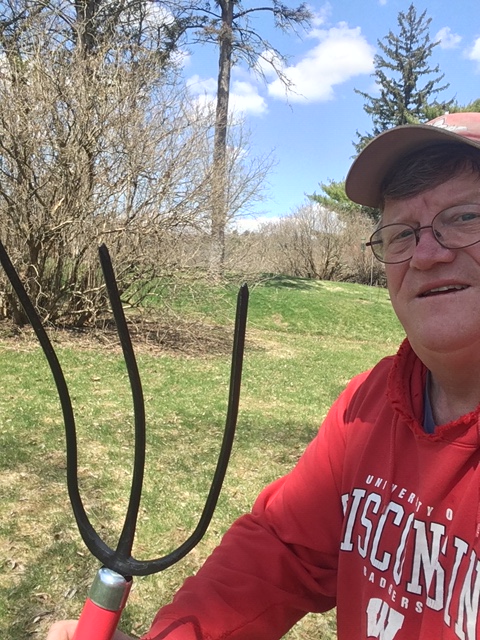
The importance of a new three-tined hay pitchfork might be lost on some, but not to most folks who’ve spent any amount of time around a farm.

We bought such a fork the other day from one of the area’s farm-supply stores; I’ve had to be reminded to leave it in the barn or machine shed since it arrived at our little farm. It’s one of the three-tined hay forks, the style used in days of yore to move loose hay or straw and certainly a staple among threshing crews.

It’s a beautiful, artistic and functional piece of equipment.

Three long and simple tines with a slight forward curve.


Fork (2)

A good and sturdy wooden handle of good length.

Solid reinforcement at the base of the handle, metal-wrapped to assure the tine-connection doesn’t break through the wood with heavy loads.

I truthfully can’t remember ever buying a new pitchfork and can recall holding only a couple at any time in my somewhat long life around farms. There always seemed to be a well-worn pitchfork to use, and even when I’ve purchased them, they’ve been scrounged from farm-auctions or other sales of used equipment.

Perhaps my grandfather or father bought a new pitchfork or two during my first 18 years on our family’s farm over at Veefkind. I don’t remember the forks there being new, if that was the case. I recall new barn-alley scrapers, new manure shovels, new silage forks, a new haylage fork and even a new manure fork. But I simply can’t remember a new pitchfork being part of the operation.

The old-timers would be chuckling at my excitement about a new pitchfork – of that, I’m certain. Their voices, even those of the long-departed, echo in my mind about how having such a beautiful new pitchfork in my hands makes about as much sense as teats on a boar pig.

There’s no threshing in my future, they’d say; there’s no loose hay or straw to fork from a wagon and into the mow or out of the mow and into the cows; there isn’t even a need to fork chunks of small bales up and down mangers.

The truth is that there really isn’t a desperate need for a new pitchfork our little farm on Eimon Ridge, where there once had been full requirements of the oldtimers’ needs of owning a new pitchfork. But the other day I looked at the pile of long and stringy twigs piled beneath our farm’s grand old willow and realized that a pitchfork would be the best tool for managing them.

A pitchfork could be a handy tool for the willow twigs, I surmised, but there likely should be other rationale for spending the time and money on something so important as a pitchfork. Reminiscing and essays about such a tool wouldn’t suffice; more important reasons would be needed.

And then, I looked up to the shed where we store large round hay-bales for the resident beef cattle and horses. I remembered that the shed’s floor always is covered with upwards of a foot of loose hay, and that I’d long meant to get that old hay out of the way.

The new pitchfork would work grandly in removing that loose shed-hay and would add to my excuse use some of the hay as mulch for my gardens.

And then, I looked to our small barn, which for several years had housed my small herd of brood-sows and feeder-pigs. Maybe, I thought, I could convince my wife that having a new pitchfork would mean that I should build another herd of hogs – my rationale being that the fork would be used to manage the hogs’ bedding materials.

A sheep or two could possibly arrive in the barn to make that fork’s presence even more worthwhile, I thought.

However, my mind returned to the realities that I most likely would never have the barn again filled with hogs or any new sheep. I’d have to instead depend on that old tree, the old hay in the shed and the love of my gardens as the most basic reasons for having that new fork.

There’s a chance, of course, that a soul really doesn’t need too many reasons for owning a new pitchfork. It’s a tool like the jackknives so many old farm folks carry around in our pockets: Many reasons are found to have it because it’s available.

Few things are more frustrating than not having a jackknife when it’s needed; few things are more frustrating than not having a pitchfork when it’s needed.

Those truths hold true even when similar tools are at-hand. A job that calls

 for a jackknife usually can’t be done as well with a crosscut saw; a job that calls for a good three-tined hay pitchfork can’t be done as well with a manure fork.

There’s no doubt many chores will be found for my new pitchfork.

I’ll even promise to keep it in the barn or shed and not take it into the house.

— Scott Schultz

Kissed by a goldfinch

The staccato hammering echoed across our farmyard as one of the resident pileated woodpeckers repeatedly slammed his face into the flesh of an old catalpa tree.

I’ve noticed over the years the incredible force with which those crow-sized birds whack trees in search of tiny critters lying under bark and beyond. There’s little wonder why, with such head-hammering, that sort of woodpecker’s flight is so choppy and that their call is the laugh-cry-scream of a brain-addled human.

A flitter caught my attention on a nearby tree, pulling my eyes from the pileated woodpecker. There, I saw two smaller woodpeckers quickly doing a bit of pitter-pattering with beaks much less smaller than the pileated’s proboscis. Their neck-jarring hammering also was much quicker and seemed less precise than that being done by the larger bird.

In a couple moments, one of the smaller woodpeckers flitted its way to our bird-feeding station and clamped its feet onto the edge of one of the feeders. It contorted its neck to reach for a few of the feeder’s seeds, still snapping its head at the seeds as though working the most hardened bark.

It occurred to me about then that I’ve known people who attempt to show love or passion by kissing akin to the way the woodpeckers were kissing the trees and those seeds. Indeed, I’ve been kissed that way, tightened lips and flashing teeth slamming into my cheek or lips with such force as to punch a hole in a white-oak tree.

In my youth, such woodpecker-like attempts at kisses were quick deal-closers for anyone seeking my attention. I valued my lips more than a second date with a girl who kissed like a woodpecker.

Then which of the birds, if any, might be worthy of a second date based on their kissing skills?

I glanced around the farmyard and saw a robin hopping along, searching for the right moment to slam its face into the ground to snatch a worm or other soil-bound critter into its beak. Like the woodpeckers, there would be no second-date consideration for the robin because of the pointedly quick whacks they make.

The cack-cack-cack-whistling of a red-winged blackbird drew my attention toward an evergreen. Incessant cack-cack-cack-whistling. A cack-cack-cack-whistling so incessantly annoying that even such a lovely bird wouldn’t have made the cut for even a first date. Its kissing abilities likely would never have mattered.

The same went for the glowing beauty of the cardinals and blue jays perched in the nearby bushes, both so beautiful but such bullies that no other yard-birds dare get in their paths. No warm and loving kiss-tests for them, either.

Just then, I caught a glimpse of two goldfinches landing on opposite sides of our bird-feeding station’s tubular thistle-seed feeder. They’d approached the feeder in the shyness of hesitant flight, seeming to only hope they’d be welcomed. And then, their small feet gripping the feeder’s little perches, they simultaneously reached their mouths toward the feeder.

Gently, their beaks probed into the feeder to find and savor the best seeds they could find within. Except for the two or three inches of feeder separating them, it seemed they were reaching with measured passion to meet in the softest of kisses to sate their hunger with the same fullness as the feeder’s seeds.

It’s an odd thought, I know, that of which sort of birds would make the best kissers – if birds could kiss. But from what I saw that spring morning at our little farm along Eimon Ridge, I suspect the finches would be the best feathered smoochers.

If I’m to be kissed by a bird, then, let it be a goldfinch – at least until the oriole and hummingbird migration arrives.

— Scott Schultz

A Winter Eulogy

­­­­­…In the spring a fuller crimson comes upon the robin’s breast;

In the spring the wanton lapwing gets himself another crest;

In the spring a livelier iris changes on the burnish’d dove;

In the spring a young man’s fancy lightly turns to thoughts of love….

Alfred, Lord Tennyson, “Locksley Hall”

Lord Tennyson’s words are among the classic introductions to spring, which the calendar has brought to us upon the wings of a cool breeze and the vernal equinox.

Few are the words, though, that honor that last day of winter – the day some might feel best forgotten.

We tour the town and the rural countryside to seek the words and scenes fitting to adequately honor the old winter’s last day.

It’s that last day of winter when school students still are wearing snowsuits and aren’t allowed out for recess without their boots. It’s still winter, after all.

It’s that last day of winter when people still have to bundle up to take their dogs for walks, do their farm chores or otherwise carry on with daily outdoor duties.

It’s that last day of winter when an American Legion bugler has to find his ear-muffs to add his mournful 24 notes of Taps to the breeze during a departed comrade’s last earthly honors.

The grass has found its way from under the snow by the time winter’s last day arrives. And so much forgotten during winter reveals itself on that last day.

Piles of icy snow remain, their crystals signs that the snow is finally relenting to March’s high sun.

Sitting behind the window of a house or a barn or a pickup truck might fool us into thinking spring already has made its visit. We venture outside to realize the sun’s intense glare reflected off the remaining snow, which momentarily offers warmth. But after a few moments, that solar warmth is pushed aside by winter’s last breeze pulling chilled goosebumps from the ice and depositing them on our skin.

I’d been away from our farmyard for most of this last winter’s day, only to have seen it playing out in those aforementioned ways. The chill settled in the goosebumps the wind had deposited onto me – in great part because I’d dressed for a spring day instead of a winter day. A lament of foolishness about my clothing choice swirled in my mind when I happened upon the Leopold benches parked under the overhang on the west side of our old farmhouse.

The sun by then had passed its noon midpoint and started its late-afternoon journey into the western sky. Its full March warmth found me at those benches, which our old house’s angles were keeping out of the wind.

And there, the sun offered a eulogy for winter and prepared for the morrow’s baptism of another new spring. That last day of winter was reluctantly passing the season’s torch on to spring’s warmer days.

I took my place on the Leopold bench to ponder for a few moments the passing of that winter and of spring’s arrival. There was some joy in the seasons’ exchange; there was reflection and wonder in how there got to be so many such exchanges during my lifetime.

Where has winter gone?

What will spring offer?

When did those many seasons catch up to my being?

There on that bench, I found solace in having known so many winters-turned-springs.

There on that bench, I took joy in the fortune of having been given so many winters-turned-springs.

All the birds that stayed at our farm through the depths of winter’s snow and cold likely would remain through the seasonal exchange. In a few weeks, they would be joined by those birds and butterflies and bugs that prefer only warm seasons.

The neighborhood beef cattle-, horses- and deer-in-residence soon would graze in pastures green.

The trees would bud and leaf; the flowers would sprout and blossom.

In a few weeks, tractors and planters would take to the northern Driftless Area’s fields. Gardens would be planted in anticipated of homegrown bounties of goodness.

An old friend once told me that Aldo Leopold had designed the benches named for him to be a bit uncomfortable so as to not hold wanderlust-filled spirits in contemplation too long in a single place. Honoring that, I rose from my bench and moved on to the next chore.

With me moved winter’s last light and its wind’s last whispers through the farmyard trees’ branches. The moon, which on coming equinox would be full in celebration of the new season, was glowing in the east.

I honored the eulogy whispered on the wind, but mourned only for the aging in my own bones marked by its passing.

There was respect in my spirit for winter’s time here, but I’d shed no tears. Instead, I silently promised myself only a return to that bench the next day to join the land in celebrating the new spring.


Peering into a favorite snow globe

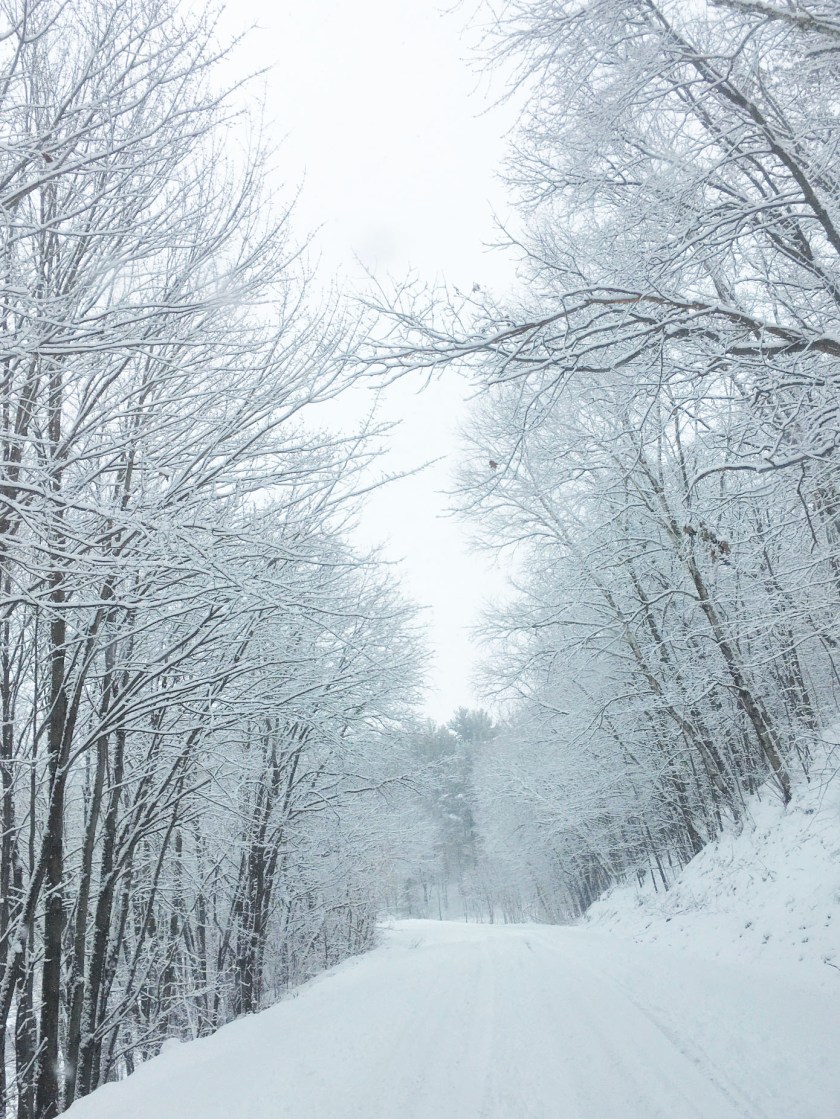
A puff of wind wiggled a spruce tree’s branches just enough to transform my world into a snow globe. The shake initially erased all around me into whiteness, and then gradually cleared to only a few sparkling white ballerinas dancing on liquid air.

Cardinal feeder snow 110117As the final flakes settled, I pondered how it seemed the countryside was much more clear than it had been before the snow globe was shaken. It’s funny how that works, I’ve often thought, such loss of sight and then extra clarity when sight returns.
Perhaps it’s because I increase my focus on seeing through the falling flakes to the beauty of our rural countryside and its community.

Perhaps it’s because a good shake of the snow globe helps wash the rank and dust from the air.

Perhaps it’s because snow globes tend to light flames of imagination and creation, giving a mind the chance to slip through the clear containers’ hardness to enter worlds near and distant.

Perhaps it’s because there is simply no fun in allowing a good snow globe to sit on the shelf without the globe getting an occasional shake. No matter how striking their scenes, snow globes are meaningless unless the flakes are stirred into their liquid atmospheres.

I would never dare to guess whether others have felt the same effect, but there have been many times through my life when it took a good shake of my snow globe to remind me about where I should be and what I should be doing.

It’s appropriate that the shake occurred the other day, just as I was heading down the path of signing onto an organization to do more writing about this region’s communities.

As the whiteness resettled around me that day, I considered how this has become the snow globe that I know as home more than any others. The old dairy farm at the place called Veefkind over in Clark County certainly will forever hold my roots with an unrelenting grip, but the snow globe that is this place on the ridge overlooking Timber Creek truly is my home.

Sometimes I suspect that the generations of Eimons who years ago settled on this place peer into the snow globe to share with me what drew them to this countryside – the globe’s snow settling to reveal incredible vistas captured in the northern reaches of the Driftless Area that was left untouched by glaciers.

With me they see a community of people who still put premiums on neighborliness, friendship and learning.

With me they see people within reaches of the soil, many of them still elbow-deep.

With me they see ridges, coulees and small towns where learning is valued and young people thrive.

With me they see people of great creativity of words, music, performance and visual art.

With me they see places from which people can travel great distances to do important work, but their hearts and souls never really leave this snow globe’s sphere.

Over the years I’ve shaken many snow globes from many places.

Those other places’ globes all revealed beauty in their own ways, but none pulled me in with quite the mesmerizing effect that grabbed me when I peered into this place’s orb.

This, I know, is where I want – where I need – to be.

These are the people, I know, I want to be my neighbors.

This is the place, I know, where I want to tell the stories about the countryside, our communities and their people.

This is the snow globe, I know, where it’s perfect to complete life with my family.

Some people believe it’s not good to become lost in a single snow globe. It’s better to only look inside without allowing yourself to be trapped inside.

Maybe the magic, then, is in assuring your spirit is allowed to move freely in and out of your chosen globe. Even the most wondrous of places sometimes can feel too confining.

Still, it’s this snow globe we call Eimon Ridge into which I shall most enjoy gazing, and into which I think so many of this countryside’s neighbors also like to peer.

There, together, we’ll see the past, present and future, and share all the wonders we’ve viewed.

Along the way, I hope we remember to give our snow globe an occasional shake to help renew our vision.

— Scott Schultz

Winter leaves

Snow leaves 123019

Parts of nature sometime seem impossible to paint in words.

I’ve often surmised that perhaps those things are meant to remain seen only by the eyes and then live in mind, spirit and heart – not meant to be hung on living-room walls or become part of some self-indulgent writer’s poetry. But there’s also the chance of that sort of thinking exposing me as being too willing to take the easy route when failing to describe one of the land’s offerings.

I recently considered that while gauging my struggle to describe what equals leaves on trees in December.

We all know the leaves bud and bloom to their spring and summer glory, and then change in autumn to their kaleidoscope of brilliant colors; then drop to the wood’s floor to join the duff in a decay that will feed the woodlot’s future. We know the tree branches to be bared and bald I winter’s chill.

But then, the morning after an early winter snowstorm, I look up to see leaves covering the trees in white splendor. The spirits had spent the night replacing the leaves of spring, summer and fall with leaves of snow that washed clean with glowing white the otherwise dulled branches.

The leaves-of-snow I’d come to know in other late autumns and winters hadn’t lasted long under the days’ sunshine, even on cold days. However, as had occurred on some of those other leaves-of-snow mornings, this crop of white leaves melted and re-froze into crystal leaves that sparkled under the bright sky.

The sparkled trees winked down at me with their many-faceted leaves-of-diamonds.

That day’s crop of leaves would disappear soon, I knew. Yet I also knew in my soul that similar crops of leaves would cover all the trees in our farmyard and all across this northern Driftless Area’s ridges and coulees. Time would turn the calendar, and this grand planet again would tilt its northern Driftless Area face toward the sun to bring about new spring buds and leaves.

Until then, though, I’ll happily commune with the trees covered in leaves of snow and crystals.

Truly, my mere words might never fully describe those wintered leaves just as my humbled being has been unable to describe so many things in our rural countryside. If that’s the case I’ll happily gather them with my eyes and rake them into my soul where, as with fall leaves in the woods, they’ll decay into the duff to nourish my being.

— Scott Schultz

Communing with the spirit

It  was supposed to be little more than me renewing the tradition of me joining the legacy of my family and so many other Wisconsin souls when I walked out of our farmhouse that November Saturday morning.

The opening of Wisconsin’s deer hunting season was at-hand, and I was respectfully going to take my place on a stump to watch for whitetails.

I wouldn’t be too intense or business-like with the hunt, as has been my personal tradition. I’d cross the farmyard and mosey through some light brush and trees and reach that favorite stump on the back-side of our little woodlot behind our barnyard. I’d sit there for a couple of hours to casually watch for signs of deer in the Timber Creek Valley and the neighboring ridge.Spirit sky 112319

Mine is the ilk that I’ll harvest a deer if one happens past, but I won’t be disappointed if a deer doesn’t appear.

Daylight was just tickling the east horizon as I crossed the farmyard. That first light drew my eyes to the sky, where I saw the sex of a waning quarter-moon – there, my imagination picturing my beautiful Dee witting and, with a winking smile, tantalizingly waving a dangled leg toward me.

I reached the stump and kept glancing at the moon and the hues of red, orange and blue that would become the day’s sunrise.

The warmth in that gentle light and the pastels it gently stroked onto the clouds and the sky behind then started to filter down onto me. It seeped through the clothing I’d layered beneath my orange hunting gear to protect me from the morning’s chill; that warmth penetrated to my heart.

The pastel painting grew above as the sun’s fierce light drew nearer to the horizon and pushed farther into the sky. The colors were soft poetry salad-layered in blue-over-purple-over-black-over-red-over-gray-over-orange-over-red.

The sky brightened, and then the light lowered itself onto the tree branches that had been left dark since the earth claimed their leaves. The light ran down the trees’ branches and then trunks, and then turned the valley’s and ridge’s tall-grown grass to khaki. And then, it covered the ridge’s frost-covered floor to melt the white frost into a carpet of late-November green grass.

I hadn’t noticed past my awe that the light also had bled over me.

But then, I felt it.

And I felt the spirit.

The spirit reached down through those still-brightening pastels in the sky and finger-walked across the ridge and over the creek and then right up to my boots.

The spirit turned its palms to the sky and reached out to comfort me. It caressed my head and my shoulders in the warmth of its hands.

It reached its arms around me and gently pulled me into a reassuring hug.

The spirit wordlessly suggested I open to it my heart, mind and soul. I complied, and the spirit entered me.

The sky and land smiled in the realization of the morning’s full brightness, knowing they’d given to me a spiritual comfort as I’d never known.

I was safe.

I was home.

I’d met a spirit I never understood; it had been there all along but had never been such a part of me.

There it had lived, in the land and the trees and the grass and the corn and water and the sky.

My soul smiled.

The countryside stilled just then; all fell silent.

And then, a cock pheasant crowed his early morning approval of the day and a busy gray squirrel chattered its gossipy agreement.

A jay landed on a nearby branch and scolded me with its admonishment to never forget that moment I’d met the spirit. I nodded my head and smiled in our covenant.

My many years of life and the years of religious education had left me believing that I’d known about the spirit, and that my spiritual beliefs were in the right places. But that wasn’t the case.

Other people have met their spirit in different ways and in many forms. I knew on that day before the 63rd anniversary of my birth, that I’d met my true spirit.

That day, I found my own spirit and peace while seated on a stump at our beloved little farm.

That day, the spirit came of the land and the trees and the grass and the corn and water and the sky.

I’ll allow others of more religion than I to debate the spirit’s source, what it should be called and how it should be praised; some will tell me what they think I should know about the spirit. I’ll choose to allow all of that to pass by, though, because I know where my spirit is and what I know and feel when it touches me.

There, on that stump in our woods, the spirit and I communed. There, we shall continue to commune.

— Scott Schultz

Northern Driftless music

I reached for the remote-control tuner to turn on some music.

Music and writing always go together well, so while I was writing the only decision would be what genre of music would best fit my mood that day; what notes would orchestrate pulling the words from my heart and push them through my fingers.

Jazz? Classical? Rock? Pop? Country? The choices are many.

I chose geese.

The window beside my writing place happened to be open while I reached for the tuner. As I leaned into my reach, my ear neared the window and I heard the faint abafando harmony of Canada geese moving somewhere between the crisp blue October sky and the rainbowed reds, gold, orange, brown and green of the covering the northern driftless area’s ridges and coulees. As they neared, their fluted calls turned to agitato — a mess of music crossing the sky — and then to affrettando as their tune gained order and hurried across the sky. Pianississimo, mezzo forte, forte, mezzo forte, pianississimo, their music came and went.

Why, I wondered, would I need to turn on the recorded music played on our electronic devices, when I have the live symphony of such a beautiful autumn day?

I cranked the window handle to open it to more sounds, then cranked another window open to hear it even more.

That wasn’t enough, though. I had a taste of the wonderful music echoing across our farmyard, and immediately was hooked. I needed more; in moments the door was open and I was stepping outside to drink in every cord and every note up and down the musical scales.

Listening to the rural countryside’s music through an open window was to hear it through a hand-cranked phonograph.

Hearing it with all the windows opened was to hear it on a portable stereo record player.

Hearing it while standing in the outside doorway was to hear it on a modern surround-sound system.

Hearing it while standing in the farmyard was to hear it while standing at the New York Philharmonic Orchestra director’s stand.

The music drew around me, its fingers and arms holding me with just the right strength so as to allow me to enjoy the moment without feeling overwhelmed by its enormous sound.

Another flock of geese – larger than the first – marched in perfect formation across the sky.

A squirrel chattered away with some harmony, and a red-tailed hawk whistled some notes.

Some percussion was added by a walnut tree, its fruit drumming the soil and rooftops as it was released on perfect cue.

A weaning summer calf bleated a solo, its mother answering again and again in bluesy tones.

I soon found myself in the symphony hall’s best seat, against the south side of a tree where the early afternoon sun warmed me and the orchestra between movements.

And then it was over – but only because I had obligations other than closing my eyes and allowing the autumn orchestra’s musical vibrations to lull me into a long nap. There was writing to do, and I’d found the music to accompany me along the way.

The words were bursting to get out of my soul and dripping from my fingertips by the time I re-entered the house. They would be words coaxed from me like few other and would quickly-but-purposefully flow from me like melodies caressed from an expertly played cello.

They were the notes and words of the northern Driftless Area’s music.

They were the notes and words of place.

— Scott Schultz

Rattling through the corn

The corn has been speaking in its fall dialect, which tightens my skin into autumn goosebumps.

I stopped farmyard work the other day to pause and listen to the corn’s death-rattle calling. And, though the day was unseasonably warm, the corn’s leaf-rattling still carried an October fall chill on the breeze.

The rattling conjures visions of jack-o-lanterns, trick-or-treaters and frosted rooftops.

It rides the breeze hand-in-hand with comforting smells of wood fires that keep neighbors warm.

The rattling even shows the way for the sweetness of the coming harvest, when combines bend stalks to allow the stalks’ inner stalks to sprinkle their perfume into the fall air.

It calls me to the field to explore its inner sanctum.

Walking into a corn field during the fall has long been a necessity for rural kids of all ages. There’s a mystery scratched in the voices of those brittle leaves, and those mysteries must be explored.

Whether it’s been in the flat land of the Veefkind farm where I was raised or here on the Eimon Ridge, where the northern Driftless Area’s coulees continue to raise me, I’ve been counted among those rural kids who feel the calling to enter those fields.

In those fields, plenty of real work happens that goes beyond the whims of an aging fellow fulfilling some sort of primal calling. The fields are there as part of our rural livelihoods, and painstakingly long hours of toil and worry have gone into them – experiences I’ve known first-hand over the years.

Still, that whimsical side flourishes with each leaf’s rattle.

I have to go into the corn field.

In there, I’ll find a youngster riding on a wagon pulled behind an old one-row corn picker, the youngster dodging ears of corn on a late-October day while his yellow-chore-glove-wearing father looks back from the tractor with wonder about why the youngster would want to risk being knocked on the noggin by the hardened corn-cobs.

I’ll find memories of the horrifying news that a friend’s father lost part of a leg and a hand to the same brand of corn-picker that we used on our farm.

There will be shadows of dancing cornstalks cast by a combine’s headlights during a late-night session of harvesting.

In the field, I’ll discover wildlife that had become too complacent so deep within the corn’s rows – raccoons, pheasants and deer. I might even get to see a black-bear’s bed and wonder how long it’s been since the bear was nestled there.

I’ll see the tracks of farm vehicles and farmers’ feet, left in the spring-dampened soil when the corn’s journey was started – when hope was at its highest.

The corn field isn’t for everyone, of course. I know several people with aversions about those fields, those aversions growing as the corn matures. The death-rattles of leaves on brittle stalks apparently aren’t appealing to those people, and especially not at night and not as Halloween nears. I can accept that, though not fully understanding it; what some of us see as being comfort is the next person’s version of a horror movie.

To those who don’t know or don’t want to know the sense of being called into autumn corn fields, I’ll allow piles of rustling fall leaves. Jumping into a pile of leaves is itself invigorating and a joy for all ages of children. But, as wonderful as those leaves are, they don’t hold the mysteries contained in the corn.

So I’ll willingly walk through the ditch, climb through that barbed-wire fence and boldly step into the corn field that’s calling me with an autumn siren’s sensuality. As in every time I’ve done that, I have no ideas or preconceptions about what I’ll find in there.

Maybe in that corn I’ll find secrets to unlock any untapped happiness in our world.

Maybe in that corn I’ll find a needed solitude.

If there is anything about which I’m certain, it’s that I’ll find yet another needed reconnection with the soil that makes this northern Driftless Area such a spiritual place to live. It’s a connection that’s more life-giving than the oxygen I inhale on each breath.

— Scott Schultz

Knowing fall’s arrival

The calendar tells us the autumn equinox, that fancy name for fall, is upon us.

We of the northern Driftless Area didn’t need a calendar to announce fall’s arrival, of course.

The indications have been around for days and even weeks, those birds flocking, those black walnut leaves yellowing and thinning, and the sumac turning red. Oats-eating combines have been parked for a while, waiting their return to corn fields while forage choppers hum their first clattering turns on the season’s corn.

Acorns and walnuts rat-a-tat through limbs and spatter through leaves on their journeys to season-ending thumps of finality on the duff below.

Sounds of squirrels’ teeth grating against the same acorns they carried back to the trees’ heights give background to the soft trills of unassuming nuthatches and the threatening calls of bullying blue jays.

Supple has been replaced by brittle; grass and crops which through summer soothed us with gentle full-lipped kisses have started to greet us with toothy hen-peck kisses.

Fall’s approach is also announced by clumps of red and yellow on maple-filled hillsides.

It is trumpeted by pheasants whose morning crowing moves from the grasslands into corn fields.

Some of us embrace fall’s splendor, seeing a time when the countryside explodes into a big box of Crayons that more than replaces the hues gone from spring’s and summer’s flowers.

Other people see it as a time of ending, with bared trees the harbingers of winter’s chill.

Count me among those who embrace this season, and among those who absorb all the coming days bring across our ridges and valleys.

The season will be a good time for me to drive a bit west of Arcadia, to see whether I can find that incredible little church about which I wrote many years ago – it nestled within a valley spattered by every imaginable color.

It will be a good time for me to mosey down to Trempealeau to watch the river laze by while I enjoy a nice supper.

This will be the time I reintroduce myself to Judge Gale while visiting Old Main in his namesake community.

I’ll sit at the memorial park and listen for stories from previous generations coming from the quieted voices in the cemetery.

I’ll visit fall art exhibitions and start setting my eyes on the best jack-o-lantern pumpkins.

There will be moments of hurry and moments of coffee-cup contemplation in Whitehall and Blair and all the other places our area’s rural commerce is centered.

Echoes of alma maters will be heard on college campuses during weekday events and football Saturdays.

There will be moments of wisdom-seeking while my back rests against an oak in the woods.

Night will start to become our home as much as the daylight, the moon and stars shining more brightly and the daytime sky opening to brighter shades of blue.

Some weekday morning, we’ll suddenly notice the steam from our breaths as we make our ways across farmyards and fields. We’ll start noticing in the air whether neighbors are using oak or elm in their furnaces.

The morning dew so refreshing in summer when it soaked through shoes and into trousers will instead send goosebumped chills through our bones.

All won’t be leisure, of course, and I’ll be happy if I find time to do even a few of those things I mention. Besides the normal day-to-day work we all have, the season will be filled with preparations for what’s to come – finishing harvests and assuring that shelter is ready for the next season’s snow and cold.

Weatherizing will again become an important word.

We’ll remember where we stored our flannel shirts and bedding, and will exchange shorts for blue jeans.

It’s all a routine that’s evolved into us in these parts – routine that adds an extra bounce in our collective step, but which comes with some extra work that thickens the callouses on our hands.

There’s not really a need for the season to be noted on calendars. Call it the autumn equinox or fall or anything else you’d like, but we definitely know when the season has arrived in the northern Driftless Area.