Uncovering memories in the snow

I took a few carefully measured steps in the snow before turning around to see what my footprints looked like. The snow showed me more than I’d expected.

Curiosity had gripped me as I watched the amazing whiteness fall a few nights ago. Something was making me wonder what my tracks look like — that reason for wondering not understood but more of a reflex.

Making the first footprints in the snow has never been my favorite thing to do. The best snow, I’ve always believed, is that onto which no being has trod. When the first tracks are stenciled upon it, a lonely small-animal track making a singular path across the whiteness is my favorite.

Those tracks, beyond answering my unfounded curiosity, would bring a measure of sadness. Normally for me, humans need not apply for the role of making the first ripples on a smooth lake of new snow.

My tracks indeed showed me that my gait was askew far more than some of the odd patterns it had created during earlier years. I was hit by a sudden sense of wanting my damaged tracks to quickly be erased from that natural whiteboard.

I got my wish as the snow fell more intensely, filling my tracks and turning my passage into nothing more than a memory.

The erased tracks reminded me about how snow does that so efficiently, erasing memories of those who only moments ago passed through.

That’s when I started considering how snow, so efficient at erasing such memories, also has created in all of us so many memories that will never leave.

Each of us was the small farm boy who looked from the barn toward the house with Christmas Eve excitement as the season’s first flakes floated onto roofs. The new snow, the boy knew, would allow Santa Claus to arrive that night. All know, after all, that Santa’s sleigh can’t land on roofs that aren’t lubricated with at least a thin layer of snow.

Who among us can deny being part of an entire class rushing to an elementary-school window to gaze at an early winter snow? Nary a soul who has taught children kindergarten through fourth grade can say they’ve never had a moment of losing total control of a class as they did during when those first flakes fell outside of the classroom window.

Teachers also lose the attention of even older students, though attempts at coolness keep students in their seats while their minds rush to the window.

There are moments of digging snow tunnels in snow piled high in farmyards, at the ends of city driveways and along the edges of school playgrounds.

Smooth-edged blocks of snow stacked into snow forts and into poorly-constructed igloos never leave our minds – the walls of which most often turned into protection during epic snowball battles.

Many people recall nearly every being they’ve made with snow, and the realization that the large ball of snow they’ve rolled is too heavy to be lifted upon the even-larger ball they rolled for a snowman’s bottom. Those who can’t immediately remember will have total recall, if given a few moments.

There’s the blizzard of ’78 and the blizzard of ’92 and blizzards of so many other years that can’t be forgotten, with the old-timers recalling those even so far beyond my years.

We know memories of all the snow sculptures we’ve created, often amazed at others having difficulty recognizing our finely-sculpted dinosaurs and fish.

It’s not only childhood snow memories that never leave.

We remember seeing the excitement in our children’s and grandchildren’s young eyes as they crawl onto couches to look out with amazement at the first snow they see. We see their minds frolic in the white fluff and hear their screeches as sleds speed down the sides of our region’s ridges and into the same coulees as generations before them.

We remember days of going to school on cross-country skis and on snowmobiles.

On the farms, we remember every sow that farrowed and every dairy-barn pipe that froze during the latest great blizzards.

In these parts, we tell stories about flying with grace from the ski-jumps that used to dot the northern Driftless Area.

And on the most perfect days, we remember sitting in front of a cabin’s fire, book-in-lap, while watching a snow-globe outside world of flakes pirouette and glissade their way to kiss the soil.

How, then, can the same snow that so readily covers our tracks be the same snow that makes so many memories drift into our minds?

Maybe the snow isn’t hiding our tracks. Maybe, instead, it’s just covering them and other memories for safe-keeping.

— Scott Schultz
Gifts in the Trees

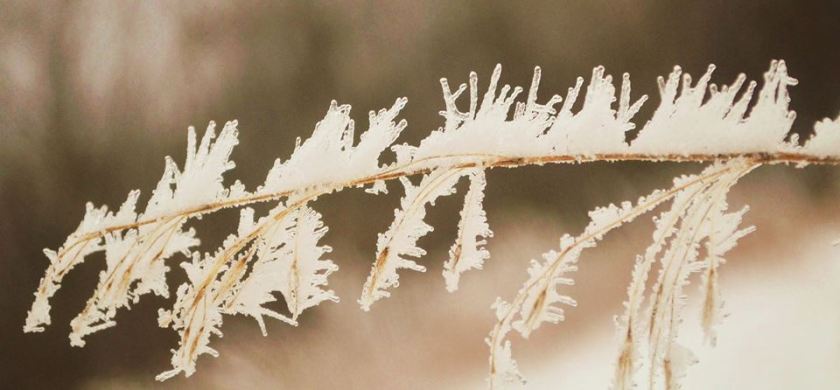
The fog that hung over Eimon Ridge as day broke the other morning left its signature in the hoar frost growing in the damp December chill.

Each inch of the fog’s blanket withdrawal piled another layer of icy crystals to decorate the otherwise-dark limbs and branches protecting the rural soil under their canopy.

I’ve never been among those who used that fake white flocking on our Christmas tree, and certainly don’t fault anyone who’s found joy in doing that. But I’ll take a day when hoar frost or snow brightens the trees outside with its natural flocking.

Wife Dee already had made her usual pre-dawn trek to coax young minds to hunger for learning by the time I saw the December holiday postcard. Having been raised in Florida, she expresses a special appreciation for all that’s snow which those who’ve spent a lifetime here might otherwise take for granted.

She’s never asked for diamonds, saying she finds the most valuable diamonds sparkling in the snow that dances to its resting place on our farm’s soil.

The day became even brighter for me as I opened an e-mail from her to read what she saw in the trees during her drive to the school. In the canopy over the ridge, she wrote, were the things that have made her life here special.

“Winter’s fireflies dazzled my drive from our house to all along Eimon,” she wrote.

Some people consider themselves fortunate for having gifts beneath Christmas trees; we’ve found those gifts to be good but especially are excited by such gifts left on our ridge’s trees.

This truly is a season of gifts, in many ways.

We see the gifts in photographs of children excited (some, admittedly frightened, though) visiting with Santa Claus.

We see them in the kindness we open for each other and in the spirits of giving to each other.

We hear them in every note of a caroler.

We see them in every cardinal, finch and sparrow at the feeding stations.

We see them in the year’s bounties filling barns and household larders.

We feel them in the joy we find with loves and relatives around feast-laden tables.

Winter itself also arrived as a gift, that solstice day giving the year’s time of shortest light but sending us into days of ever-growing light.

We’ll look forward to sharing hope in a new calendar year; we’ll join family and friends across the world celebrating Christmas and Hanukkah.

We’ll raise toasts to honor our health and goodwill, and to honor those who’ve passed before us.

And then, the holidays with all their excitement and joys will pass. But gifts always will be found in the trees.

— Scott Schultz

Reflections in hoar frost

Reflections in hoar frost
Fortunate are those who know the added value of winter gifts involving simple afternoons of relaxing with good books and good love in the warmth of our homes, while watching birds at feeding stations or while watching more snowflakes refresh the whitened soil. While enjoying those many winter gifts, we occasionally reflect upon that December morning when fog turns our treetops into frosted gifts so grand. In the sun’s light will hoar frost diamonds glisten; in the moon’s light fireflies will flicker. It’s good, I think, to know there’s good beyond the fog and to know what’s good beyond the coming winter’s long chill.

A hushed reminder of the season

The tires on a car passing our farm the other day had a message for me.

From the treads of those tires came a steady “shhhhhhhhh” as they rolled into contact with the snow on Eimon Road’s aging pavement, an invitation for me to stop and listen to the countryside as the season’s first heavy snow fell.

The sound covered even the car’s engine noise as it descended the ridge’s grade while on the way to County Highway G. Responding to its first invitation, I stopped momentarily in the early morning cold and dampness to consider how the vehicle’s engine might not even have been running, leaving the tires to make its only sound. That was possible, I knew, because of stories I’d heard from the neighborhood guys about how, as children, they’d coasted down the ridge on their bicycles for more than a mile before (most often) stopping at Highway G.

But as it passed, I heard the faint engine noise — quieted as though, like me, it had heeded the tires’ message to only whisper.

Finally, the car was around the curve east of our house, leaving silence even its hushing message disappearing into the falling snow.

And then there was no sound, not even the otherwise ever-present drone of the Interstate highway a few miles to the east.

There were no sounds echoing around our rural ridges and coulees – no pheasants crowing, no songbirds chirping, and no migrating geese honking.

There were no tractors humming and no cattle mooing.

Sounds that we hear on our farm nearly every other day had disappeared.

It was that early season snow, I knew, that drank the sounds into the depths of each of the gazillion snowflakes falling. They seemed to fatten themselves on the sounds they inhaled, landing on me and the trees and the grass as grotesquely huge and bloated flakes.

The snow was full of the fall sounds that our crisp country air normally allowed to dance across the ridges.

The quiet wouldn’t last, of course. But when later snowfalls covered the countryside with a thicker duvet, the crackling-dry winter air would echo even the slightest sounds for miles.

Later that day, the temperature would return to where it had been the last few weeks. Later that week, the temperature would return to where it had been a couple months earlier. But that morning the muffling hush created by the snow served notice that things soon would change. The change might not totally occur until the end of December, but that snow reminded me that the change certainly was on its way.

The quiet was notice that there would be changes in the way we act and think about the world around us.

It was notice that we need to help each other, too. I thought about how that need motivates guys such as those Knights of Columbus members at St. Raymond’s Catholic Church out in the Foster area. They’re the guys who each year sell belly-warming rosettes to raise money so they can provide coats to families who can’t afford them.

I thought about “Pajama Grandma” at Whitehall whose work keeps children warm while they sleep.

I thought about Fred and his people at Pigeon Falls who so conscientiously work on the Toys for Tots program to help make more children’s holidays happy – and the U.S. Marines who each year work so diligently to get that program off the ground.

The quiet also was notice that the winterizing we didn’t get done in the past few weeks had better get finished.

It reminded me – and likely plenty of others that day – that I need to glance at the LP tank’s gauge to assure that there’s as much fuel in there as I expect.

It was a reminder that I need to check to assure that emergency kits, ice/snow scrapers and snow brushes were in the vehicles. And it reminded me to assure that all the vehicles and farm equipment were winterized.

How much more there might be for me to do, I thought, but not nearly as much as there would be for the real farmers who are my family and neighbors. Theirs are challenges about which I only reminisce and observe these days; every day, those farmers meet winter’s challenges head-on with “bring-it-on” attitudes.

The snow continued to fill the air and ground with fluffy whiteness as I turned to go back into the house. There, I noticed a different sort of chill on my feet. The wet of morning dew or rain had often soaked through my shoes in recent months, but that didn’t compare with the momentary iciness I felt from the snow.

The calendar says it’s still fall. That morning, though, it was winter because nature made it winter – forget the calendar.

And it was quiet because nature wanted us to listen.

— Scott Schultz

Peering into a favorite snow globe

A puff of wind wiggled a spruce tree’s branches just enough to transform my world into a snow globe. The shake initially erased all around me into whiteness, and then gradually cleared to only a few sparkling white ballerinas dancing on liquid air.

As the final flakes settled, I pondered how it seemed the countryside was much more clear than it had been before the snow globe was shaken. It’s funny how that works, I’ve often thought, such loss of sight and then extra clarity when sight returns.

Perhaps it’s because I increase my focus on seeing through the falling flakes to the beauty of our rural countryside and its community.

Perhaps it’s because a good shake of the snow globe helps wash the rank and dust from the air.

Perhaps it’s because snow globes tend to light flames of imagination and creation, giving a mind the chance to slip through the clear containers’ hardness to enter worlds near and distant.

Perhaps it’s because there is simply no fun in allowing a good snow globe to sit on the shelf without the globe getting an occasional shake. No matter how striking their scenes, snow globes are meaningless unless the flakes are stirred into their liquid atmospheres.

I would never dare to guess whether others have felt the same effect, but there have been many times through my life when it took a good shake of my snow globe to remind me about where I should be and what I should be doing.

It’s appropriate that the shake occurred the other day, just as I was heading down the path of signing onto an organization to do more writing about this region’s communities.

As the whiteness resettled around me that day, I considered how this has become the snow globe that I know as home more than any others. The old dairy farm at the place called Veefkind over in Clark County certainly will forever hold my roots with an unrelenting grip, but the snow globe that is this place on the ridge overlooking Timber Creek truly is my home.

Sometimes I suspect that the generations of Eimons who years ago settled on this place peer into the snow globe to share with me what drew them to this countryside – the globe’s snow settling to reveal incredible vistas captured in the northern reaches of the Driftless Area that was left untouched by glaciers.

With me they see a community of people who still put premiums on neighborliness, friendship and learning.

With me they see people within reaches of the soil, many of them still elbow-deep.

With me they see ridges, coulees and small towns where learning is valued and young people thrive.

With me they see people of great creativity of words, music, performance and visual art.

With me they see places from which people can travel great distances to do important work, but their hearts and souls never really leave this snow globe’s sphere.

Over the years I’ve shaken many snow globes from many places.

Those other places’ globes all revealed beauty in their own ways, but none pulled me in with quite the mesmerizing effect that grabbed me when I peered into this place’s orb.

This, I know, is where I want – where I need – to be.

These are the people, I know, I want to be my neighbors.

This is the place, I know, where I want to tell the stories about the countryside, our communities and their people.

This is the snow globe, I know, where it’s perfect to complete life with my family.

Some people believe it’s not good to become lost in a single snow globe. It’s better to only look inside without allowing yourself to be trapped inside.

Maybe the magic, then, is in assuring your spirit is allowed to move freely in and out of your chosen globe. Even the most wondrous of places sometimes can feel too confining.

Still, it’s this snow globe we call Eimon Ridge into which I shall most enjoy gazing, and into which I think so many of this countryside’s neighbors also like to peer.

There, together, we’ll see the past, present and future, and share all the wonders we’ve viewed.

Along the way, I hope we remember to give our snow globe an occasional shake to help renew our vision.

— Scott Schultz

Making changes with the land

“The world around us doesn’t change; we change. Sell your clothes and keep your thoughts.”

I was considering that Henry David Thoreau quote early the other morning while I leaned against one of the old oaks down by our springs that feed the beginnings of Timber Creek. My purpose for being there on a chilled late-November day had to do with hunting whitetail deer but, as usual, my mind was drifting to and fro about this and that with every rattle of the oak’s dry copper leaves in the breeze.

Old Henry’s ideas about simplifying make sense to me sometimes more than others. Of one thing I’m certain, though: I’m sold on his notion of spending simple time reflecting about our basic connections with the land, whether it be a place like his beloved Walden or our beloved Eimon Ridge and Timber Creek Valley.

I was mindlessly looking at the dull khaki grass across the valley, adding a little more context to my considerations about Thoreau’s idea about things not changing. The grass had changed greatly since I’d last really paid attention to it, previously filled with lush green and waltzing to summer breezes’ rhythms; that November morning it stood as rigid as the oak’s limbs and as brittle as an old barn’s windowpanes.

The water bubbling from the spring and gargling its way into the creek is chilled even on the hottest of summer’s dog-days; I knew without touching the water that it was even colder in the November air within moments of leaving the temperature-controlled hiding place within the ridge’s soul.

Perhaps some things change after all, I was thinking. The changes might be in a different context to what Thoreau was thinking, but I started to picture the ever-cycling changes we know on our soils across this countryside.

Light already had opened the eastern sky to the new day, and my contentment had been in seeing the azure above to make that day brighter than the cloud- and haze-covered dreariness we’d known in the days previous. The sunrise seemed at first to otherwise be bringing nothing of special note.

And then, all changed about that very morning.

The change started with a small line hinting pink – and then red – over some of that khaki grass on the ridge across the creek. The line slowly stretched wider, and with the ease of a paint-roller in slow motion the real sunrise turned the dulled grass into a kaleidoscope of reds Monet couldn’t have matched.

The morning had kicked over a five-gallon pail of red paint, and it was swathing its own paths across each of the land’s contours.

I could feel my eyes opening as the color spread across the grass. I wouldn’t have noticed right then if the grandest of whitetail bucks could have been standing within feet of me; I wouldn’t have cared. No living creature could have been as spectacular as the sunrise’s outside-the-lines coloring project.

When I thought nothing could have made for a better scene, I caught notice of a twinkle in a creek-bottom birch tree of which I’d made little note before that moment. That little twinkle of light reflecting from a couple of the tree’s highest limbs started spreading down the tree, the sun creating a whitened torch standing among the ever-darkened and leafless tag alder brush.

The tree continued to bright from top to bottom, a beacon agreeing to stand vigil with me over nature’s creativity.

And then, the light reached the birch’s lowest branches and lit red firelight to a bush below.

A short gasp escaped from my chest. Had I been so in awe of the sunrise’s performance art that I’d momentarily stopped breathing? If that was the case, it wouldn’t have been the first time that happened to me while my heart feasted on the northern Driftless Area’s natural art.

The day having gotten into its fullness, I slid down against my oak to think more about what I’d witnessed and what Thoreau had written.

Thoreau was wrong and Thoreau was right, I decided. Things around us – at least out here around our Eimon Ridge – are in constant change. And, so are we.

Measures of warmth from old furnaces

The wood-burning furnace sitting at the end of a driveway along Highway 121 down by Pigeon Falls looked lonely and unloved when I passed it the other day, and I considered the unfairness in that.

The furnace likely provided warmth and comfort for a nice family during its years of service. But there it was, looking a bit abandoned but for the “for sale” sign announcing that it still had ties with the folks to whom it gave warmth.

There likely are plenty of folks – even in here in our northern Driftless Area — who don’t think much about the importance of such a utilitarian piece of equipment. Furnaces are mostly forgotten in and around homes, except for those winter moments when they malfunction on a sub-zero January night.

I’ll proudly stand and proclaim my long-standing appreciation for those underappreciated beacons of warmth. I admit to even being a little defensive when it comes to my wife Dee and other Southern relatives referring to them as “heaters.”

Heaters are what you use in small spaces; furnaces maintain winter warmth in bigger places such as our old Eimon Homestead farmhouse up here on the ridge between Pigeon Falls and Osseo.

I’ve occasionally given consideration about why furnaces have been fairly important to me, other than the obvious fact that we’d most likely freeze to death without them in these parts. I’ve generally concluded that my thinking has to do with a big, single furnace register which gave warmth during my youngest years in my family’s old farmhouse over at Veefkind.

A single big register – maybe 4-feet-by-4-feet and resting just inside the living-room doorway from the dining room – was the only source for heat from the big old fire-breathing furnace in the basement below.

I had friends who feared we’d fall into the furnace’s hellish fire if the register’s decorative iron grate might ever fail. While that fear lingered, however, I knew the heat register to be a morning gathering place for warmth and hugs; a comforting place for a small child to curl up with a blanket on a cold winter morning.

Having the house’s single heat source in the living room assured our family would gather near it in the living room on those coldest days and nights, dispersing to icy-cold places distant in the house not an appealing consideration.

The furnace also brought our entire neighborhood together, families up and down our rural road gathering farm-to-farm to share the work of cutting and splitting firewood on cool autumn days. The smell of tobacco smoke mixes in my memories with the smell of sawdust and the mystery of how my father and other neighborhood farmers could work so steadily and hard with cigarettes dangling from their mouths.

It took many years for me to appreciate the way my family was drawn around the furnace register. Likewise, it took many years for snow-dampened cold fingers with wood-slivers in wet yellow chore gloves to turn into romantic memories of firewood-making. In the meantime, I found little sorrow the day my father announced that we were joining the 20th Century and installing an oil-burning furnace in the house.

My joy ran high on those days when I returned from school to see a local furnace-installation company’s workers installing duct-work into the old farm house. We were modern, the same way the place had been modernized with the indoor toilet installed soon after my birth.

The place I sit to write in the old Eimon house was built sometime around 1868, when the place was homesteaded. Somewhere in the wall behind me is an old chimney that more than a century ago felt the warmth of burned firewood; another chimney still forming part of the living room wall in the next room having felt the same warmth. But today, as I look out the windows to see large snowflakes falling on a cold November day, I trust the modern liquid propane furnace in the basement to kick on and occasionally throw some warmth through vents piped throughout the house.

A rational part of me says our furnace and the duct-workings we have are good – though, admittedly, I wouldn’t mind even more modernized geothermal and solar systems.

And then, I see a semi-retired wood-burning furnace for sale along the highway. I step into the farmyard and smell oak wood-smoke wisped up the Timber Creek valley and onto Eimon Ridge from our neighbor’s wood-burning furnace. When that happens the wistful side of my being makes me want to travel back a generation or two on that wood smoke and revisit those furnaces of yore.

If I had an old iron furnace register like that from the Veefkind farmhouse of my childhood, I’d occasionally lay it onto the floor of our Eimon Homestead home and invite my family to gather around it for warmth. It wouldn’t even matter that the heat is coming from a fancy LP-fueled furnace and blown through vents along the walls.

— Scott Schultz

Scratching my fer or agin’

In case you haven’t heard about it, there’s an election coming up on Tuesday.

Now, take a deep breath.

In and out.

Slowly.

That’s it. You can do it.

Feeling better?

I’m not one to wax poetically or any other way about politics as they’ve come to be, other than that we’ll hopefully find our ways back to old friends, neighbors and relatives who’ve huffed away in political disagreement. Dan Lyksett, an old long-time journalist friend, used to occasionally stick his head into my office this time of the year and ask whether I’m “fer or agin’” – his words wonderfully summing up the differences that we manage to overcomplicate into fits of insult-throwing and name-calling.

I’ll keep to myself about whether I’m fer or agin’ and move ahead with what I’ve known as my longstanding obligation to mosey my way over to Pleasantville and stand in line for a few minutes to vote at our Hale Town Hall. And then, I might take in a bit of the traditional Pleasantville election-day dinner at the church a few steps across county Highway O from the Town Hall.

Yes, that’s right – lunch. We in the rural countryside such as which covers this northern Driftless Area still know what’s important, and that fully includes getting together with neighbors to sit for a bite and bring our widened political ilks back into a more neighborly circle.

Food, we know, has a way of doing that, and I have a waistline that stands to prove that I’m fully fer when it comes to such neighborliness.

Some have been telling me my curmudgeonly attitudes are slowly increasing with my age – well, to be honest, some actually argue that it’s quickly advancing. Part of that is how I like to stick with some of the older and traditional ways of going about things.

Attending an election-day dinner, whether it be in Pleasantville or somewhere else in the area, is one of those matters those non-curmudgeons don’t seem to grasp. Forget about getting together to break bread with your neighbors, they say; who wants to sit and talk with somebody who didn’t vote the same ticket as them? Those people disagree and, by golly, they can yell at each other on election day, the day after the election and in the weeks and months and years that follow.

In places such as Pleasantville’s election-day dinner, people find other things to talk about besides the election. They talk about things that bring our communities together and the things that bond us together.

The way I like to vote is another of those things about which some in my close family and friends say I’m more than a bit curmudgeonly. That includes liking to stand in the line to cast my ballot on the official election day, and then to cast my ballot on an actual paper ballot.

I know there are important reasons for early voting, absentee ballots and electronic machines and fully appreciate assuring that everyone gets a chance to vote. I even cast absentee ballots a few times (one per election – honest) while I was places distant with my U.S. Marine Corps comrades.

Though those other options exist, I like the way election days’ excitement takes me back to the comfort of my earliest memories.

In them, I hear the voice of old town of Sherman Board chairman Lowell Schultz – my grandfather – talk about election-day preparations over at the old Sherman Town Hall.

I see the American flag hanging outside the Town Hall’s front door, elections being among the few occasions they hung the flag outside that door.

I see only the backs of the legs and feet of my parents, grandparents and neighbors as they pulled closed the cloth that hid them in the mysterious municipal confessionals.

I wanted to hear my pencil scratching a piece of paper so valuable just as I heard it scratching those hallowed ballots under the hands of many generations of voters who stood in those curtained booths.

And then, just as mysteriously as the booths themselves, my parents kept from me the secrets about who they voted for whether it be Kennedy, Nixon, Johnson or Goldwater. I wanted to someday hold that same important secret.

I’m not sure whether it’s much of an inconvenience, but I appreciate those town of Hale poll workers who these days allow me to follow my somewhat curmudgeonly tradition. But each election they hand the paper ballots to me and, with what seem to be understanding smiles, point me to the single booth where those like me go to scratch our pencils onto paper away from those non-curmudgeons who are OK with those electronic gizmos.

When I walk out of the Town Hall on Tuesday, I suspect there will be a certain relief that this election cycle is over even if I get to the Pleasantville election-day dinner. But I know – without doubt – that I’ll quickly again long for the next election.

Crossing morning paths

The haze of a morning fog settled into the trees up the road from our farm along Eimon Ridge the other day, the fog and rising sun switching positions in the sky.

As they crossed, rays rode the light mist to dance through the woodlot’s trees, bringing rustling applause from the remaining audience of October leaves gold, red and orange.

It was another of so many special moments in Wisconsin’s northern Driftless Area – so special that I scolded myself for not having carried a camera with me. I thought momentarily about taking my own advice that I’ve shared with many and take a picture with my eyes and later develop it in words. But that morning, I wasn’t patient enough for the words to come.

Besides, the walk back to the farm to get a camera to carry back to that fall scene would be a little extra exercise I could use.

The process, thankfully, still was under way upon my return. I caught the rays’ darting dance-steps in the trees, and then turned to the valley below, where Timber Creek is reborn with every bubble of the ridge’s springs. There, most of the fog already had passed below the sun, allowing brightness to rock-skip high above Jeff and Beth Larson’s pond and explode with paint-ball battle colors into the treetops poking through the haze.

I was happy with what I saw.

I was happy with what I’d captured with the camera.

I was happy with what I’d captured in my soul.

I hurried back to our farmyard, what I’d seen fighting its way out of me – and maybe even out of the camera – to be shared. It was too much splendor for one being to hold.

Dee, my wife, was the first person with whom I shared, via an e-mail. I think she liked them.

“The fog and the color are great juxtapositions,” she wrote to me.

“Yes,” I replied. “Juxtapositions were what I was seeking.”

They really were good examples of juxtapositions, but I’ll admit that might not be what I was thinking about when my finger pushed the shutter button. The reference reminded me about the day an East Coast university professor told me my book was “an interesting rural sociology study,” when I thought it was a bunch of stories about living in the rural countryside.

It feels good to know about juxtaposition, rural sociology and all that great stuff. Where the fog and the trees were concerned that morning, though, my first thoughts simply were about how striking the scene was: another of nature’s special moments. But when I sat and thought more deeply about what I’d seen, juxtaposition included, my mind shifted to the struggle I’d just witnessed between the sun’s brightness and the fog’s attempt to filter that brightness as their paths crossed.

We in these parts spend plenty of time in such struggles this time of the year, the nature of our natural beings wanting to prepare for semi-hibernation, but our worldly human beings fighting to keep life moving at a brisk pace.

Some of us especially will feel that struggle as we turn our clocks back an hour, to what we’ve been calling standard time. That hour, for some of us, will mean much in getting back into closer-to-natural sleep rhythms. Though I understand the reasons for having daylight savings time, that simple hour keeps me perpetually tired.

During daylight savings time, our clocks are the fog trying to shroud the rising sun. And, like that day on Eimon Ridge, the sun and all its brightness can’t be hidden for long. Some folks might show up at church an hour early when standard time returns, and some cows might be milked a little earlier than normal. But before we know it the sun will again shine onto the tree-tops, right on time by any measure of time.

There are, of course, many more metaphors for that meeting of sun and fog in our rural northern reaches. I’m sure I’ll think of more as I travel the region in coming weeks – me and autumn wending our ways through our coulees.

Sometimes we’ll label what we see as being stunning juxtapositions. Sometimes we’ll simply label what we see as being nature giving us another day of northern Driftless Area art.

— Scott Schultz

Fear not in October’s moonlight

Those fingers were there again when I went outside the other night, invisible as they reach from the sky but appearing on me and the soil to give us an eerie tickle.

The images of tree’s branches shadowed in an October night’s moonlight are ever-present this time of the year.

I knew it would be a restless night, with sleep interrupted by the moon’s brightness, the barking of farm dogs, the whiny cry of a resident screech owl and the yappy arguments of neighborhood coyotes.

It seems as though the moon can move the tree’s branches and limbs just enough to have those shadow-fingers tickle the critters into an all-night frenzy.

This time of the year, we talk much about spirits and goblins – and for some reason have developed a literature- and movie-induced national fascination with vampires and zombies. For some reason, our instincts are wired in ways that allows us only to concentrate on moving forward when it’s totally dark outside; but, on moonlit nights, makes us look over our shoulders to see what’s behind us.

Apparently, we don’t sweat – or in the critters’ cases bark, screech or yap – about what we can’t see in the darkness. What we see can’t hurt us. But we get plenty worried about what we can almost see floating around the shadow-fingers in the moonlight.

Or, it could be that the pursuers can so better see the pursued in those shadow-fingers cast by the moon, the fingers pointing to the pursuers’ innocent prey.

It’s so sad that natural evolution or society has wired instincts in most of us to be leery of those moonlit nights, or of the trees’ shadows. It would be so much better if we could realize that we’re safer in being able to actually see any danger. It would be so much better if we saw the trees’ shadow-fingers as dancers on our rural soil instead of as evil reaching out to do us harm.

When we push those instinctual fears aside, we can see our rural countryside as we seldom get to see it.

Folks got to see it that way more in the days when every township section in this part of the countryside was filled with farmers. Much of the land is still farmed these days, but the number of farmers working the land has dwindled.

Those farmers who still get to work the fields on fall nights get to see what so many more did 30 or 40 years ago. They got to see our rural world in that different light than we see it during the light of day.

To a person driving a tractor or a combine, that soft light of which we’re so fearful can be far more soothing than the daytime sun’s harsh rays. It’s relaxing to the driver and seems even to relax equipment that can inexplicably seem to run more smoothly at night.

Yes, that’s it: So much seems to run smoothly at night.

Our senses – admittedly likely sharpened by the instinctual fears – also run more smoothly on a moonlit October night than they do at other times.

The air we take in snaps our mind alive with a crisp freshness that foretells the coming of winter’s iciness with air that will slap us awake. It’s alive with the faint scents of the wood’s fermenting leaves and the sweetness of newly-combined corn and the richness of oak burning in a neighbor’s furnace.

From the fields we hear the faint scraping of leaves still clinging onto broken cornstalks left in a combine’s wake. And from another direction we hear dried oak leaves rattling from branches with the message that they intend to hang on for the duration of fall and most of winter.

We look down the valley to see the grassy shadows gently waving, bringing forth memories of early summer’s green lushness but the dim light hiding the reality of the grasses’ brownness, its stalks having long since discharged its season’s seeds.

In the sky, we see the handle of the Big Dipper starting to move its handle to — as many children are told — turn the dipper upside-down so water doesn’t collect and freeze during the coming days and months. If we’re lucky, we see the faint dancing of the northern lights and, if we’re extremely lucky we see the northern lights’ colors stretching brightly from the northern horizon and extending over our heads.

The soft night light also seems to slowly seep from the soil through our shoes and jackets, little needles of cold gently pricking our toes and souls to tell us to keep moving.

After stopping to see what the fall night’s moonlight brings to rural places such as our Eimon Ridge, it’s easy to see why families such as the Eimons chose these ridges and coulees to farm so many years ago.

Here, the shadow-fingers aren’t threatening; they’re inviting.

Here, we need not look over our shoulders in fear; the land, the creatures and the spirits will protect us.